Rocky habitats ranging from sediment-free shallow rocks to sediment-rich rocky areas at
somewhat greater depths. The species is closely associated with small to medium-sized rocks that provide
shelter and spawning sites, and is rare where rocks are scattered over open sand.
Geographic distribution:
Widely distributed in Lake Malawi. Occurs along the entire Tanzanian shore from Matema to Hai
Reef and extends into Mozambican waters as far south as Lumbaulo. On the Malawian coast it is found between
Mdoka and Usisya. Populations formerly known as Maylandia sp. ‘zebra chilumba’ are now regarded as
geographical variants of Maylandia fainzilberi.
Typical adult size:
In the lake, males usually reach up to about 13 cm total length, with females about 25% smaller.
In aquaria, males commonly grow larger and may reach 17–18 cm.
Sexual dimorphism:
Strongly pronounced. Males have a blue ground color with distinct dark vertical bars and often
show yellow to golden coloration on the chest and throat; dorsal fin color varies between populations and
may range from blue to yellow or orange. Females are brown to bluish gray, usually lacking a distinct barred
pattern. O (orange) and OB (orange blotched) morphs occur, particularly in females.
Recommended aquarium size:
400 L.
Aquarium setup:
Aquarium should be dominated by rockwork forming many caves and hiding places. Best kept in a
harem of one male with 2–3 females, or in larger groups in sufficiently spacious tanks. Due to its robust
and aggressive nature, aggression is reduced when housed with other large, hardy algae-grazing mbuna and
when ample visual barriers are provided.
Diet:
Omnivorous mbuna. Feeds mainly on Aufwuchs scraped from rocks, consisting of diatoms and algal
strands, but also takes plankton and small invertebrates. Frequently observed feeding in schools in the
water column.
Breeding:
Breeding males defend territories centered around caves among rocks, often with neighboring
males less than one meter apart. Spawning takes place inside the cave. Females are maternal mouthbrooders
and usually hide solitarily while holding. Clutches typically consist of 20–40 eggs, with release of fry
after about three weeks, followed by immediate abandonment.
Aggression:
Aggressive within the species; generally tolerant toward other species but highly territorial,
especially males.
Special notes:
This species shows marked polychromatism, including O and OB morphs, which are especially common
in females. It is one of the most widespread and abundant large zebra-type mbuna and shows a higher
tolerance for sediment-rich habitats than many related species.
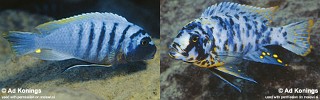
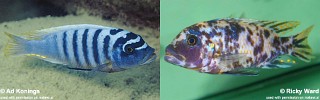
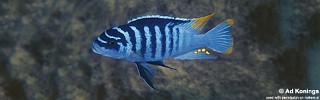
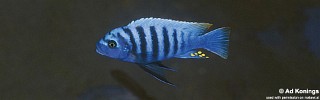
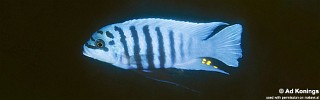
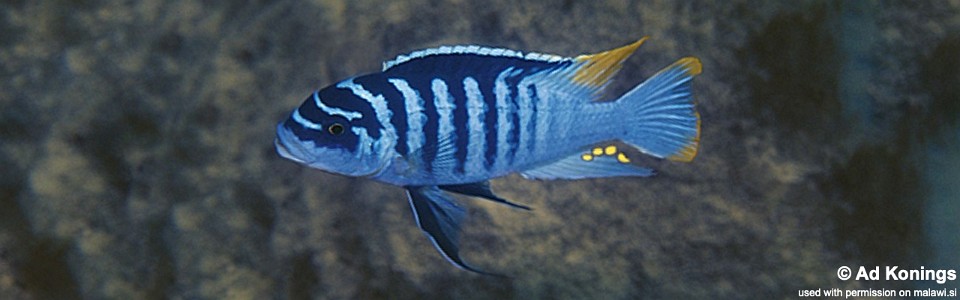




Photo gallery