Open sandy habitat, typically at depths greater than 20 m.
Prefers fine sand to slightly muddy substrates and is often associated with areas near river outlets.
Geographic distribution:
Occurs along the eastern shoreline of Lake Malawi from Lupingu (Tanzania) to Makanjila Point (Malawi),
and locally at Nkhomo Reef along the western shore.
Typical adult size:
Males up to 14 cm; females up to 10 cm.
Sexual dimorphism:
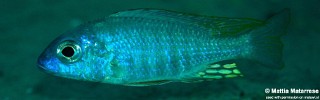
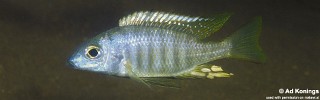
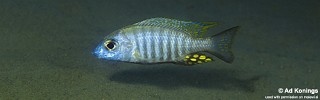
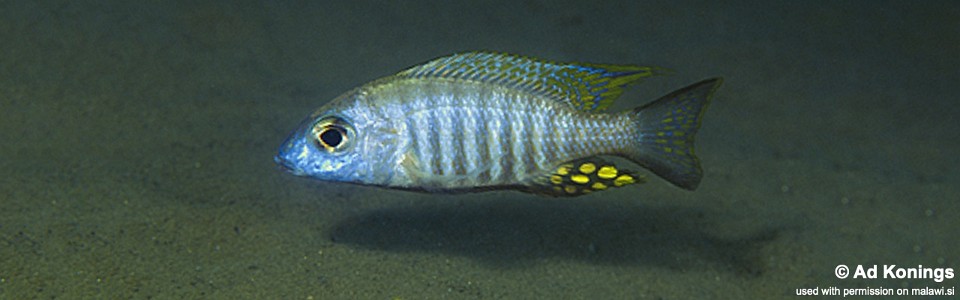
Pronounced. Males are larger and develop strong breeding coloration,
while females remain smaller and cryptically colored with slightly yellowish pectoral and anal fins.
Recommended aquarium size:
300 L (minimum tank length 100–125 cm)
Aquarium setup:
Fine sand substrate is essential to allow natural feeding and bower-building behavior.
Provide wide open sandy areas with minimal rockwork.
Can be kept with most Malawi cichlids except large predators and highly aggressive mbuna.
Keeping multiple males is possible in spacious aquaria, though not generally recommended.
Diet:
Feeds on small invertebrates living in the sand, detected using the enlarged cephalic sensory pores
characteristic of the genus.
Breeding:
Maternal mouthbrooder. Males defend shallow saucer-shaped spawning pits in the sand.
Breeding males may be present throughout the year, with territory density varying between localities.
Females occur singly or in small groups between male territories.
Aggression:
Low to moderate. Generally peaceful, with territorial behavior limited mainly to breeding males.
Special notes:
A small sand-dwelling Aulonocara distinguished by having seven vertical bars below the dorsal fin.
Females resemble those of the so-called “Chitande-type” Aulonocara but can be identified by the lower
number of bars and slightly yellowish pectoral and anal fins.
Commonly referred to in the hobby as the Blue Gold Sand Peacock.




Provide wide open sandy areas with minimal rockwork.
Can be kept with most Malawi cichlids except large predators and highly aggressive mbuna.
Keeping multiple males is possible in spacious aquaria, though not generally recommended.
Females resemble those of the so-called “Chitande-type” Aulonocara but can be identified by the lower number of bars and slightly yellowish pectoral and anal fins.
Commonly referred to in the hobby as the Blue Gold Sand Peacock.
Photo gallery