Intermediate habitat with sand interspersed with scattered rocks.
Territorial males are typically found at depths of 15–25 m, while foraging females and non-breeding males
may occur as shallow as about 3 m.
Geographic distribution:
Endemic to Lake Malawi. Found from the Ngara area southwards to Chilumba,
with strong populations at Chitande Island and only occasional records from Mdoka.
Typical adult size:
Males up to 11 cm; females up to 9 cm.
Sexual dimorphism:
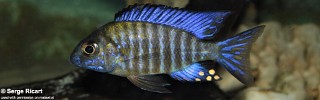
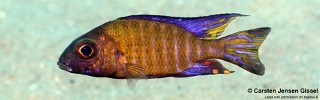
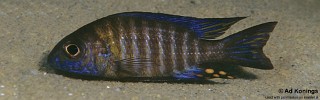
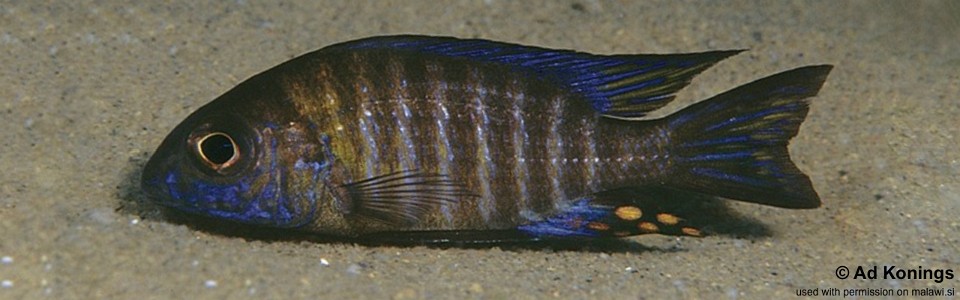
Clear. Males are larger and develop distinct breeding coloration.
Females and non-breeding males can be recognized by the presence of black lappets in the dorsal fin.
Females are generally darker than females of the so-called Chitande-type Aulonocara.
Recommended aquarium size:
300 L (minimum tank length 130 cm)
Aquarium setup:
Fine sand substrate with open sandy areas interrupted by small groups of rocks.
Keep one male with 2–3 females, or alternatively in larger groups (e.g. several males with a larger group of females)
provided sufficient space is available.
House only with peaceful cichlids; mbuna are generally too aggressive for this species.
Diet:
Carnivorous. Feeds on small crustaceans and insect larvae collected from the sand,
located using the enlarged cephalic sensory pores typical of the genus.
Breeding:
Maternal mouthbrooder. Territorial males are present throughout the year and defend their sites
mainly against conspecific males.
Spawning usually takes place inside a cave, but may also occur on open sand if no suitable cave is available.
Females approach male territories located at relatively deeper levels.
Aggression:
Low. A peaceful species that does not compete well with aggressive cichlids.
Aggression is largely limited to interactions between conspecific males.
Special notes:
Aulonocara ethelwynnae lacks a formal diagnostic description, but can be distinguished from
the so-called Chitande-type Aulonocara by its deeper body and by black lappets in the dorsal fin
of females and non-breeding males.
Breeding males lack the white-blue submarginal dorsal band seen in
Aulonocara sp. “chitande type north”.
The species is listed as Near Threatened, being common at Chitande Island but rare at Mdoka,
the only other locality where it is occasionally encountered.




Keep one male with 2–3 females, or alternatively in larger groups (e.g. several males with a larger group of females) provided sufficient space is available.
House only with peaceful cichlids; mbuna are generally too aggressive for this species.
Spawning usually takes place inside a cave, but may also occur on open sand if no suitable cave is available. Females approach male territories located at relatively deeper levels.
Breeding males lack the white-blue submarginal dorsal band seen in Aulonocara sp. “chitande type north”.
The species is listed as Near Threatened, being common at Chitande Island but rare at Mdoka, the only other locality where it is occasionally encountered.
Photo gallery