Sand-dominated habitat, often with slightly muddy substrate near river outlets.
Typically found at depths of 20 m and deeper; this depth represents the upper limit for most
sand-dwelling Aulonocara.
Geographic distribution:
Lake-wide distribution in Lake Malawi.
Particularly common near river mouths where the bottom slopes gradually.
Typical adult size:
Males up to 16 cm; females up to 12 cm.
Sexual dimorphism:
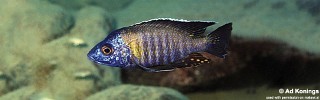
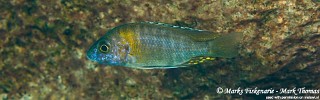
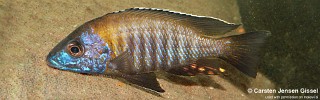
Clear. Males are larger and more robust.
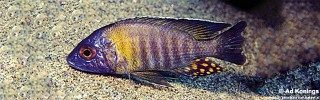
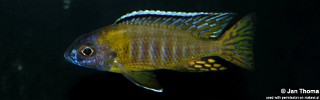
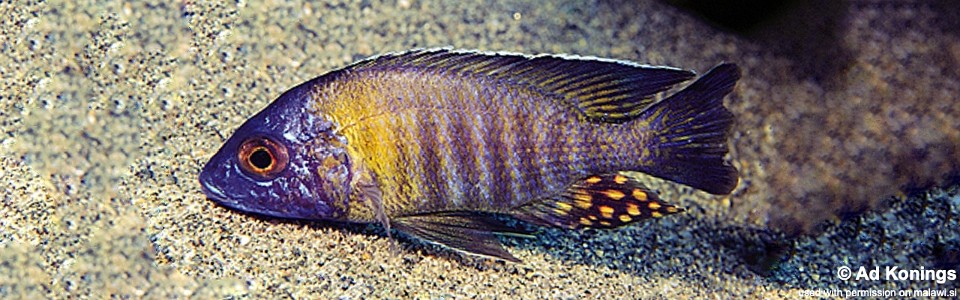
Females are easily recognized by yellow pelvic fins and yellow spots on the anal fin.
Recommended aquarium size:
300 L (minimum tank length 125 cm)
Aquarium setup:
Fine sand substrate is essential to allow natural feeding and extensive bower construction.
Provide large open sandy areas; rocks are optional but may be used as reference points for territories.
Ensure ample space if multiple bower-building species are kept together.
Diet:
Feeds on small invertebrates living in the sand.
Prey is detected using enlarged cephalic sensory pores while hovering motionless just above the substrate.
Breeding:
Maternal mouthbrooder. Males excavate very large, deep craters in the sand, often up to 60 cm in diameter,
lacking the raised rim typical of many other sand-castle builders.
Spawning sites may resemble deep sand caves.
Females occur in small groups between male territories; mouthbrooding females are usually solitary.
Aggression:
Low. A very placid species; aggression is largely limited to territorial interactions between males.
Special notes:
One of the largest and most robust members of the genus, surpassed mainly by
Aulonocara rostratum and some populations of A. guentheri.
Females are distinctive among Aulonocara by their yellow pelvic fins and yellow anal-fin spots.
Large historical specimens collected in the 1920s may represent an unusually large population closely related to,
or possibly conspecific with, Aulonocara gertrudae; rediscovery of this form could clarify taxonomic uncertainties.
Northern populations (north of the Ruhuhu River) may show slightly more orange coloration on the neck and shoulders
and occasionally defend caves instead of open sand.




Provide large open sandy areas; rocks are optional but may be used as reference points for territories.
Ensure ample space if multiple bower-building species are kept together.
Spawning sites may resemble deep sand caves. Females occur in small groups between male territories; mouthbrooding females are usually solitary.
Females are distinctive among Aulonocara by their yellow pelvic fins and yellow anal-fin spots.
Large historical specimens collected in the 1920s may represent an unusually large population closely related to, or possibly conspecific with, Aulonocara gertrudae; rediscovery of this form could clarify taxonomic uncertainties.
Northern populations (north of the Ruhuhu River) may show slightly more orange coloration on the neck and shoulders and occasionally defend caves instead of open sand.
Photo gallery