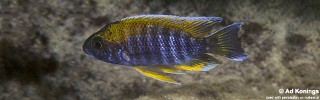
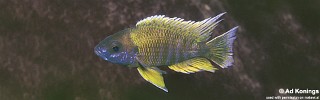
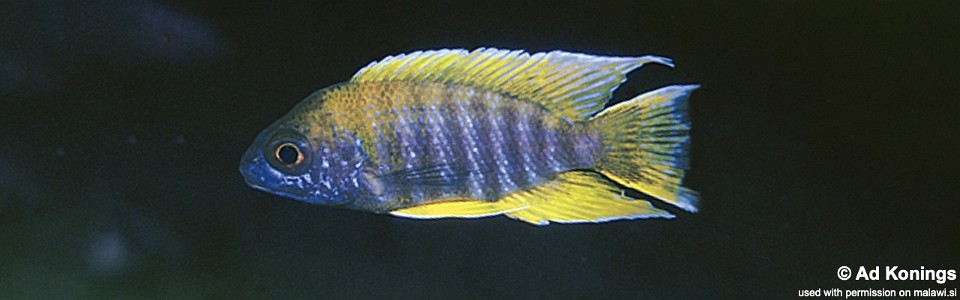
Off Makanjila Island (likely Otter Point), Lake Malawi.
Biotope:
Sediment-rich rocky habitat and intermediate zones.
Breeding males occupy caves; northern populations (except Undu Reef) mainly inhabit pure rocky areas with large boulders,
while some southern populations occur in intermediate habitats with smaller caves.
Geographic distribution:
Widely distributed in Lake Malawi, including Chitande Island, Mpanga Rocks, Chirwa Island, Namalenje Island,
the entire Cape Maclear area (including Mumbo Island), from Domwe Island to Makokola Reef, and Chemwezi Rocks.
Also occurs along the Tanzanian coast (e.g. Undu Reef, Hongi Island, Lupingu) and in Mozambique (Lumbaulo).
Typical adult size:
Males up to 12 cm; females up to 9 cm.
Sexual dimorphism:
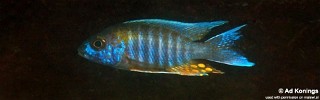
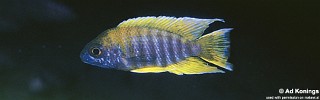
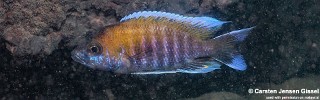
Pronounced. Males develop strong breeding coloration that varies geographically.
Females are smaller and generally similar across populations; females from southern populations often have
orange anal fins, while those from northern populations usually have colorless anal fins.
Recommended aquarium size:
300 L (minimum tank length 130 cm)
Aquarium setup:
Fine sand substrate with open sandy areas interrupted by piles of rocks that create caves.
Keep one male with 2–3 females, or in larger groups (e.g. several males with a larger group of females)
provided sufficient space and many caves are available.
House only with peaceful cichlids; aggressive species should be avoided.
Diet:
Carnivorous. Feeds on small insect larvae and crustaceans taken from sand and sediment within caves
or from sediment-covered rocks, detected using enlarged cephalic sensory pores.
Breeding:
Maternal mouthbrooder. Males defend territories inside caves; large caves may hold several breeding males.
The dominant male often occupies the upper part of the cave.
Spawning takes place on rock or sand; no spawning pit or dish is constructed.
Aggression:
Moderate. Confident but generally peaceful; should not be housed with aggressive cichlids.
Aggression is mainly restricted to territorial interactions among males.
Special notes:
Originally described as Trematocranus jacobfreibergi, this species is characterized by an extremely short snout
compared to related taxa.
It can be distinguished from most other Aulonocara by its relatively small sensory pores in the skull bones.
The species is highly sedentary and shows strong geographic variation in male coloration, resulting in numerous
recognizable local forms (e.g. Mpanga Rocks, Undu “Mamalela”).
Although listed as Least Concern overall, some local populations—especially at Undu Reef—have been severely reduced
by over-collection for the aquarium trade.




Keep one male with 2–3 females, or in larger groups (e.g. several males with a larger group of females) provided sufficient space and many caves are available.
House only with peaceful cichlids; aggressive species should be avoided.
The dominant male often occupies the upper part of the cave. Spawning takes place on rock or sand; no spawning pit or dish is constructed.
It can be distinguished from most other Aulonocara by its relatively small sensory pores in the skull bones.
The species is highly sedentary and shows strong geographic variation in male coloration, resulting in numerous recognizable local forms (e.g. Mpanga Rocks, Undu “Mamalela”).
Although listed as Least Concern overall, some local populations—especially at Undu Reef—have been severely reduced by over-collection for the aquarium trade.
Photo gallery