Eccles Reef (Chimwalani Reef), near Makanjila Point, Lake Malawi.
Biotope:
Intermediate habitat at depths of approximately 12–18 m.
Usually found over sand directly bordering submerged rocky reefs with large boulders and extensive caves.
Geographic distribution:
Endemic to Lake Malawi. Restricted to the submerged reefs of Chimwalani (Eccles Reef)
and Luwala Reef.
Typical adult size:
Males up to 12 cm; females up to 10 cm.
Sexual dimorphism:
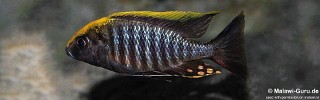
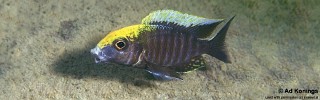
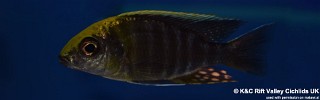
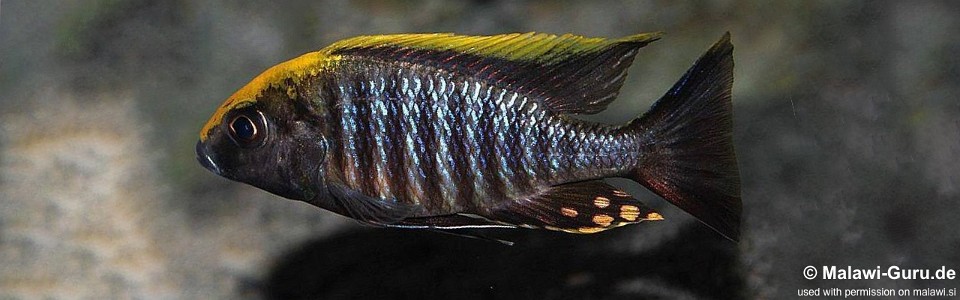
Clear. Males develop a characteristic yellow blaze on the head and back in breeding coloration.
Females are smaller and lack bright coloration.
Recommended aquarium size:
300 L (minimum tank length 130 cm)
Aquarium setup:
Fine sand substrate with open sandy areas, combined with rock piles forming caves,
preferably stacked high toward the back of the aquarium.
Keep one male with 2–3 females, or in larger groups (e.g. several males with a larger group of females)
if sufficient space and hiding places are available.
Should be housed only with peaceful cichlids; mbuna are generally too aggressive.
Diet:
Carnivorous. Feeds on small invertebrates living in the sand,
detected using the enlarged cephalic sensory pores typical of the genus.
Breeding:
Maternal mouthbrooder. Males defend territories beneath large rocks,
usually positioning themselves at the entrance of a cave to attract females.
Territorial defense is relatively static and consists mainly of fin displays
and short chases of rival males.
Aggression:
Low. Generally peaceful, but territorial males will defend their caves against conspecifics.
Special notes:
A distinctive species characterized by the yellow blaze on the head and back of breeding males,
often referred to as the “Sulfurhead” Aulonocara.
Closely related to Aulonocara kandeense and the so-called “Yellow Collar” forms,
with a risk of hybridization in captivity; these species should therefore not be housed together.
Listed as Critically Endangered due to its extremely restricted distribution and suspected decline
caused by over-collection for the ornamental fish trade, despite not being targeted by local fishermen.
In aquaria, individuals may grow considerably larger than in the wild.




Keep one male with 2–3 females, or in larger groups (e.g. several males with a larger group of females) if sufficient space and hiding places are available.
Should be housed only with peaceful cichlids; mbuna are generally too aggressive.
Territorial defense is relatively static and consists mainly of fin displays and short chases of rival males.
Closely related to Aulonocara kandeense and the so-called “Yellow Collar” forms, with a risk of hybridization in captivity; these species should therefore not be housed together.
Listed as Critically Endangered due to its extremely restricted distribution and suspected decline caused by over-collection for the ornamental fish trade, despite not being targeted by local fishermen.
In aquaria, individuals may grow considerably larger than in the wild.
Photo gallery