Sand-dominated habitat, usually in the vicinity of rocks.
Appears to prefer deeper sand habitats and only approaches rocky areas temporarily, possibly for breeding.
Geographic distribution:
Southern part of Lake Malawi.
Confirmed records are very limited and suggest a highly restricted distribution.
Typical adult size:
Males up to 13 cm; females up to 10 cm.
Sexual dimorphism:
Clear. Males develop breeding coloration with a blue head and a bright orange patch on the nape and shoulder.
Females are silvery with eight faint vertical bars on the flanks.
Recommended aquarium size:
300 L (minimum tank length 120 cm)
Aquarium setup:
Fine sand substrate is essential, combined with a few rock structures for reference and shelter.
Large open sandy areas should dominate the aquarium layout.
Provide ample swimming space rather than dense rockwork.
Diet:
Carnivorous. Feeds on small insect larvae and crustaceans living in the sand,
located by detecting movements beneath the substrate using enlarged cephalic sensory pores.
Breeding:
Maternal mouthbrooder. Actual spawning behavior has not been directly observed in the wild.
Males in breeding coloration have been seen occupying small cleared areas and may temporarily defend
modest spawning sites without constructing a true bower.
Aggression:
Low. Appears to be a peaceful sand-dwelling species with limited territorial behavior.
Special notes:
Taxonomic history of this species is complex; only a single specimen is considered the true holotype,
while other original specimens were later described as Aulonocara guentheri.
Distinguished from A. guentheri by the bright orange nape and shoulder patch in breeding males,
which is dark gray-golden in that species.
The species has never been exported and has no established trade name.
Very few individuals have been observed in the lake, suggesting either extremely small populations
or a preference for deeper habitats rarely surveyed.
The first so-called “Blue Peacock” exported from Malawi was incorrectly identified as
Aulonocara nyassae; it was in fact a form of Aulonocara stuartgranti.
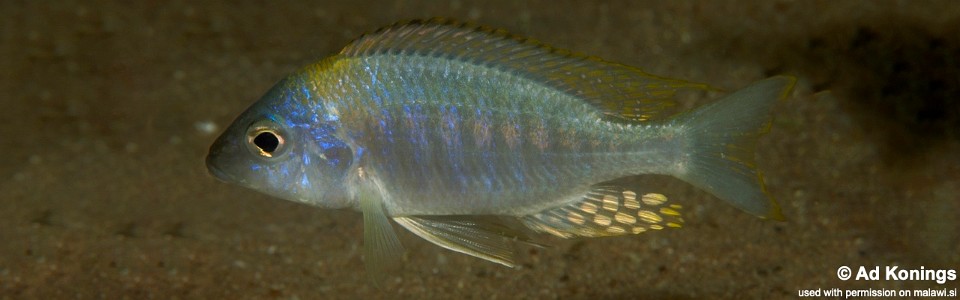

Large open sandy areas should dominate the aquarium layout. Provide ample swimming space rather than dense rockwork.
Males in breeding coloration have been seen occupying small cleared areas and may temporarily defend modest spawning sites without constructing a true bower.
Distinguished from A. guentheri by the bright orange nape and shoulder patch in breeding males, which is dark gray-golden in that species.
The species has never been exported and has no established trade name.
Very few individuals have been observed in the lake, suggesting either extremely small populations or a preference for deeper habitats rarely surveyed.
The first so-called “Blue Peacock” exported from Malawi was incorrectly identified as Aulonocara nyassae; it was in fact a form of Aulonocara stuartgranti.
Photo gallery