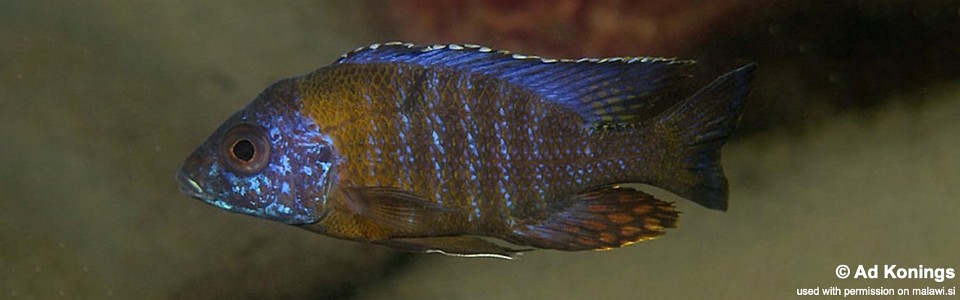
East coast of Lake Malawi, approximately 8 km south of Masinje.
Biotope:
Intermediate habitat. Occurs over sand patches between rocks and is not bound to a fixed territory.
Recorded at depths from about 7 to 35 m, most commonly around 12 m.
Geographic distribution:
Widely but patchily distributed in the southern and eastern parts of Lake Malawi.
Recorded from the east coast near Masinje, around Likoma Island, between Domwe Island and Monkey Bay,
and along the Mozambique coast at Londo. Also present at Undu and Hai Reef in Tanzania.
Not recorded from the northwestern coast of the lake.
Typical adult size:
Males up to 14 cm; females up to 11 cm.
Sexual dimorphism:
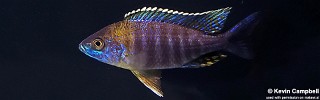
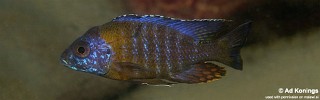
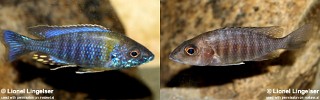
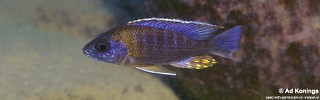
Both sexes are overall dark in coloration.
Females are dark brown, with vertical bars blending almost completely into the background color.
Males in breeding coloration are darker and can be distinguished from similar forms of
Aulonocara stuartgranti by a narrow black submarginal band in the dorsal fin.
Recommended aquarium size:
300 L (minimum tank length 130 cm)
Aquarium setup:
Fine sand substrate with scattered rocks creating open intermediate zones.
Keep one male with one or two females.
Should be housed only with peaceful cichlids; aggressive or boisterous mbuna are unsuitable.
Diet:
Carnivorous. Feeds on small invertebrates living in sandy substrates,
detected by “listening” for prey movements using the sensitive sensory pores on the head.
Breeding:
Maternal mouthbrooder. Unlike most Aulonocara, breeding males do not defend permanent territories.
Males and females roam singly, foraging over sand patches between rocks.
Spawning likely occurs opportunistically when a ripe female encounters a male.
Aggression:
Low. A peaceful species that does not tolerate aggressive tankmates well.
Special notes:
A distinctive dark-colored Aulonocara in which females lack the clearly contrasting barring
typical of most congeners.
Northern populations show a slightly greenish snout in breeding males,
while males from the Masinje area have a blue snout.
Although uncommon at all known localities, the species is not considered threatened
and is listed as Least Concern.




Keep one male with one or two females.
Should be housed only with peaceful cichlids; aggressive or boisterous mbuna are unsuitable.
Males and females roam singly, foraging over sand patches between rocks. Spawning likely occurs opportunistically when a ripe female encounters a male.
Northern populations show a slightly greenish snout in breeding males, while males from the Masinje area have a blue snout.
Although uncommon at all known localities, the species is not considered threatened and is listed as Least Concern.
Photo gallery