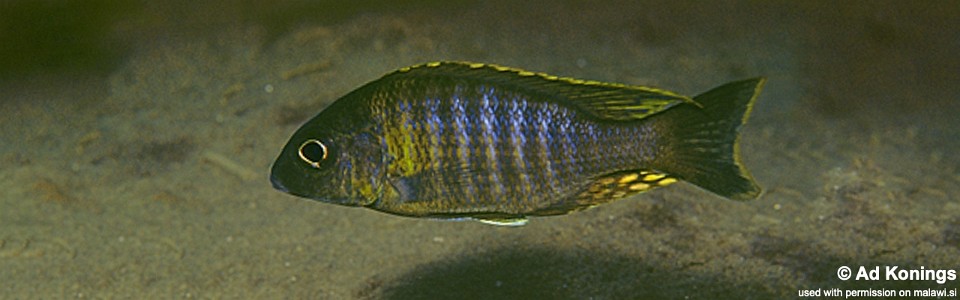

Intermediate habitat, typically over open sand.
Territorial males are usually found close to rocks, while groups of females and juveniles gather on sand
several meters away from rocky areas.
Geographic distribution:
Endemic to Kande Island, Lake Malawi.
Typical adult size:
Unknown.
Sexual dimorphism:
Present. Males are darker than other Chitande Type forms and differ in dorsal-fin edging;
females are generally indistinguishable from females of other Chitande Type Aulonocara.
Recommended aquarium size:
300 L (minimum tank length 125 cm)
Aquarium setup:
Fine sand substrate with limited rock cover.
This species prefers open areas and does not rely heavily on caves.
Diet:
Feeds on small invertebrates located in the sand by detecting tiny movements of prey beneath the surface.
Breeding:
Maternal mouthbrooder. Males weakly defend shallow spawning dishes in the sand between or near rocks,
mainly against conspecific males.
Females move in large schools a few meters away and are led to the spawning sites when ready to spawn.
Aggression:
Low. Males are weakly territorial and may leave their territory to feed.
Special notes:
An undescribed “Chitande Type” Aulonocara form. Among the Chitande Type variants,
the Kande Island form is reported to have the darkest overall male coloration.
Compared with Chitande Type North, males differ in dorsal-fin edging (white at Kande versus black margin in the northern form).
Not evaluated by the IUCN. Because the known population is very small and restricted to one island,
it may be highly vulnerable to overfishing and local extinction.
At Kande Island, it occurs in the intermediate habitat alongside Aulonocara stuartgranti (yellow form)
and Aulonocara kandeense.
Females move in large schools a few meters away and are led to the spawning sites when ready to spawn.
Compared with Chitande Type North, males differ in dorsal-fin edging (white at Kande versus black margin in the northern form).
Not evaluated by the IUCN. Because the known population is very small and restricted to one island, it may be highly vulnerable to overfishing and local extinction.
At Kande Island, it occurs in the intermediate habitat alongside Aulonocara stuartgranti (yellow form) and Aulonocara kandeense.
Photo gallery