Intermediate habitat, usually over open sand.
Groups of females gather on open sand, and even males in breeding coloration are often found
several meters away from protective rocks.
Geographic distribution:
Southeastern Lake Malawi, from Chiloelo (Mozambique) to Ntekete (Malawi).
Typical adult size:
Males up to about 9 cm, females up to about 7 cm.
Sexual dimorphism:
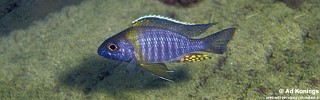
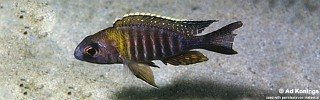
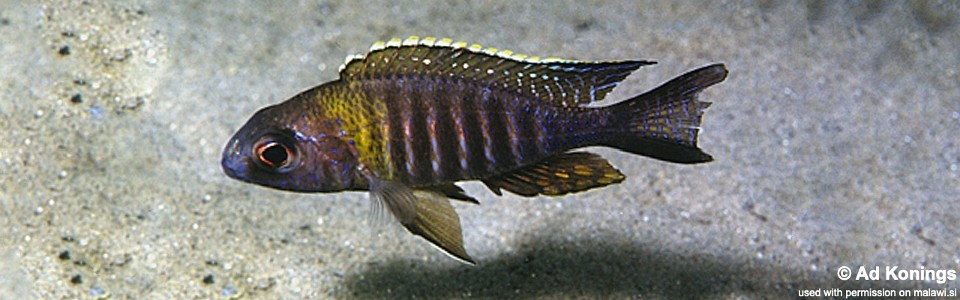
Present. Males in breeding coloration show more blue on the body than closely related Chitande Type forms.
Females are similar to those of other Chitande Types and are difficult to distinguish.
Recommended aquarium size:
300 L (minimum tank length 125 cm)
Aquarium setup:
Fine sand substrate with limited rock cover.
This species prefers open areas and does not rely heavily on caves.
Diet:
Small invertebrates collected from the sand, located using the enlarged sensory pores on the head.
Breeding:
Maternal mouthbrooder. Males weakly defend shallow, saucer-shaped spawning sites in the sand,
usually near a rock. Territories are defended only against conspecific males.
Rival males are discouraged mainly through lateral display rather than physical aggression.
Aggression:
Low. One of the least aggressive Aulonocara;
males are weakly territorial and generally tolerant.
Special notes:
An undescribed member of the “Chitande Type” Aulonocara complex.
Most similar to Aulonocara sp. ‘chitande type nkhomo’, though males differ in breeding coloration
and females of the Nkhomo form are slightly larger and more elongate.
Not evaluated by the IUCN. Within its known range this form is reported to be relatively common
in sandy intermediate habitats and does not currently appear threatened by overfishing.
Notably sensitive to boisterous or aggressive tankmates; may become lethargic in unsuitable communities.
Unlike most Aulonocara, keeping multiple males together may improve activity and display behavior.





Not evaluated by the IUCN. Within its known range this form is reported to be relatively common in sandy intermediate habitats and does not currently appear threatened by overfishing.
Notably sensitive to boisterous or aggressive tankmates; may become lethargic in unsuitable communities. Unlike most Aulonocara, keeping multiple males together may improve activity and display behavior.
Photo gallery