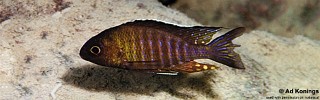
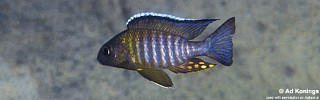
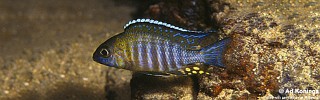
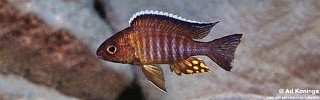
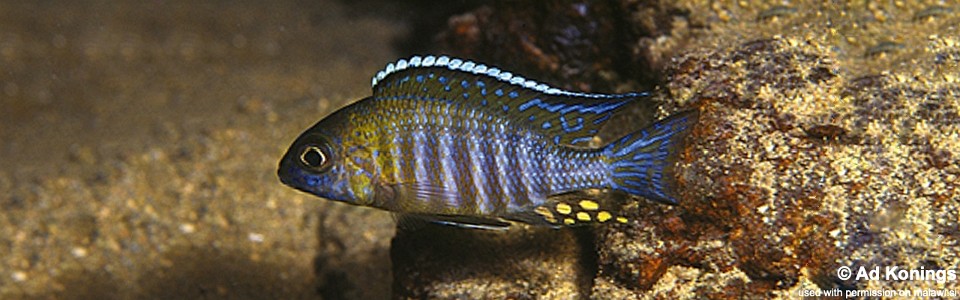
Aulonocara sp. 'chitande type mozambique' Lumbaulo
Genus:
Aulonocara
Biotope:
Intermediate habitat, somewhat more rock-associated than most other Chitande Type forms.
Usually found over sand near rocks, at depths of about 15 m and deeper.
Geographic distribution:
Southeastern Lake Malawi, from Lumbaulo (Mozambique) to Hai Reef (Tanzania).
Typical adult size:
Males up to about 8 cm, females up to about 7 cm.
Sexual dimorphism:
Present. Males show breeding coloration with a yellow patch on neck and shoulder;
females resemble those of other Chitande Type forms and are difficult to distinguish.
Recommended aquarium size:
300 L (minimum tank length 125 cm)
Aquarium setup:
Fine sand substrate with scattered rocks.
Provide open sandy areas where females can gather and limited rocky structures
that may be used by males as territory centers.
Diet:
Small invertebrates living in the sand, detected using the enlarged sensory pores on the head.
Breeding:
Maternal mouthbrooder. Males weakly defend territories against conspecifics only.
The spawning site is a shallow, saucer-shaped depression in the sand, usually near or under rocks.
Females forage in schools and visit male territories when ready to spawn.
Aggression:
Low. Weakly territorial and generally peaceful.
Special notes:
An undescribed member of the “Chitande Type” Aulonocara complex.
Most similar to Aulonocara sp. ‘chitande type masinje’, but males of that form are slightly more elongate
and show a more orange (rather than yellow) patch on neck and shoulder.
Compared to other Chitande Types, this form appears to be more closely associated with rocky areas.
Not evaluated by the IUCN. It is thought to be relatively safe from overfishing due to its deeper distribution
and proximity to rocks, which makes netting difficult.
Rarely kept in aquaria; husbandry should follow general Chitande Type guidelines,
with ample sand area and no more than one male per tank.




Compared to other Chitande Types, this form appears to be more closely associated with rocky areas.
Not evaluated by the IUCN. It is thought to be relatively safe from overfishing due to its deeper distribution and proximity to rocks, which makes netting difficult.
Rarely kept in aquaria; husbandry should follow general Chitande Type guidelines, with ample sand area and no more than one male per tank.
Photo gallery