
malawi.si

Lake Malawi cichlids — species, locations & maps

Lake Malawi cichlids — species, locations & maps
By genera By locations Locations Maps Posters Interactive map
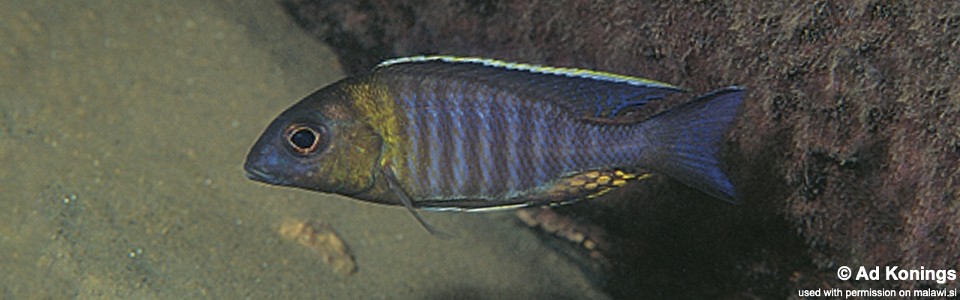
Aulonocara sp. 'chitande type nkhomo' Nkhomo Reef
Genus: Aulonocara
Biotope: Intermediate habitat, usually over open sand at the edge of a sandy reef. Groups of females gather over sand, and even males in breeding coloration are often found several meters away from protective rocks. The habitat lies at the edge of the reef where the bottom slopes steeply downward.
Geographic distribution: Restricted to the northern edge of the Nkhomo–Benga Reef, Lake Malawi. A single male observed at Jalo Reef may also belong to this form.
Typical adult size: Males up to about 11 cm, females up to about 9 cm.
Sexual dimorphism: Present. Males in breeding coloration are noticeably bluer than those of Aulonocara sp. ‘chitande type masinje’ and lack the black marginal band in the dorsal fin that characterizes Aulonocara sp. ‘chitande type north’. Females are similar to other Chitande Type forms but are slightly larger and more elongate than females of the Masinje form.
Recommended aquarium size: 300 L (minimum tank length 125 cm)
Aquarium setup: Fine sand substrate with limited rock structures. Provide open sandy areas for female groups and a few rocks near which males may establish weak territories.
Diet: Small invertebrates living in the sand, detected using the enlarged sensory pores on the head.
Breeding: Maternal mouthbrooder. Males weakly defend territories only against conspecific males. The spawning site is a shallow depression in the sand close to a rock. Females move in large schools a few meters away and are enticed to enter the male’s territory when ready to spawn. Interactions are generally slow and low-intensity, with rival males repelled mainly by lateral display.
Aggression: Low. Weakly territorial and generally peaceful.
Special notes: An undescribed member of the “Chitande Type” Aulonocara complex with a very limited distribution. Although not evaluated by the IUCN, it is reported to be very abundant at the Nkhomo–Benga Reef despite its restricted range.
At this reef, most rocks occur at depths around 22 meters, which explains why this species, together with Aulonocara baenschi, is confined to deeper water and absent from shallower nearshore reefs.

Photo: © Ad Konings
Photo: © Jurgen Van Valckenborgh
malawi.si
Lake Malawi cichlids — species, locations & maps.
All images are used with permission of the authors. Unauthorized use is prohibited.
Quick links
By genera By locations Locations Maps Posters Interactive map
Contact
Email Facebook Instagram
© malawi.si