Intermediate habitat with a strong rocky component.
Males are mainly found in shallow rocky areas and small caves within the intermediate zone.
Geographic distribution:
Known from Hai Reef (Tanzania) and Chiwindi (Mozambique), Lake Malawi.
Typical adult size:
Males up to about 14 cm, females up to about 11 cm.
Sexual dimorphism:
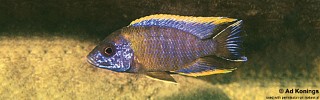
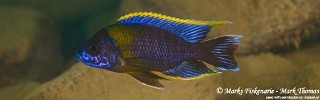
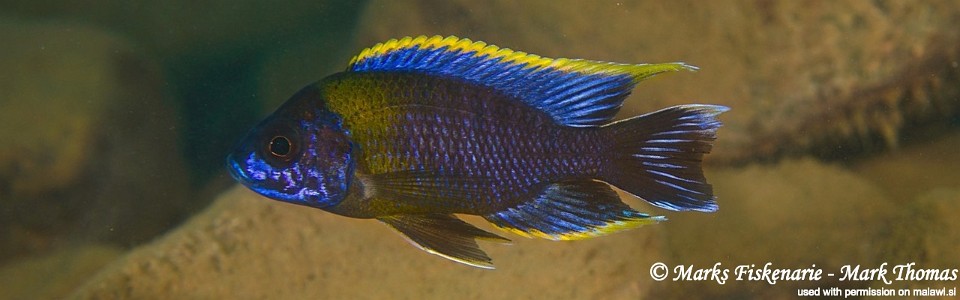
Pronounced. Males are easily recognized by the red–orange edging on the vertical fins.
Females resemble those of related species but are slightly darker than sympatric
Aulonocara stuartgranti females.
Recommended aquarium size:
Around 400 L.
Aquarium setup:
Large aquarium with fine sand substrate and extensive rockwork.
Arrange rocks to form caves and sheltered passages.
Keep one male with several females, or a larger group in a spacious aquarium.
Only house with peaceful cichlids; avoid aggressive species.
Diet:
Carnivorous. Feeds on small insect larvae and crustaceans taken from sandy cave floors
and from sediment on rocks.
Breeding:
Maternal mouthbrooder. Males defend small caves with a sandy bottom as territories.
Neighboring males may be less than one meter apart.
Females gather nearby on sand and spawning takes place inside the male’s cave,
without construction of a spawning dish.
Aggression:
Moderately assertive but generally peaceful.
Should not be kept with aggressive or highly dominant species.
Special notes:
An undescribed member of the cave-dwelling Aulonocara jacobfreibergi group.
Closely related to Aulonocara sp. ‘walteri’ and should not be kept together with it
due to the risk of hybridization.
Not evaluated by the IUCN, but considered highly threatened by over-collection for the
ornamental fish trade. Its distribution is very limited and the total population is
believed to number fewer than 1,000 individuals.
Once regarded as one of the most striking cichlids in Lake Malawi, it has become very
difficult to find in the wild.




Not evaluated by the IUCN, but considered highly threatened by over-collection for the ornamental fish trade. Its distribution is very limited and the total population is believed to number fewer than 1,000 individuals.
Once regarded as one of the most striking cichlids in Lake Malawi, it has become very difficult to find in the wild.
Photo gallery