Intermediate habitat at the edge where rocks meet sand.
Around Otter Point and Domwe Island typically found under large,
suspended rocks at depths of about 20–30 m.
Further south occurs at shallower depths.
At Mazinzi Reef extremely dense populations inhabit both sand
and rocky structures.
Geographic distribution:
Along the Nankumba Peninsula from Msaka to Mphandi Island,
including Otter Point, Domwe Island, Monkey Bay, Mazinzi Reef,
Nkudzi, Mphandi Island, and Chemwezi Rocks.
Typical adult size:
Males up to about 12 cm, females up to about 9 cm.
Northern populations tend to be slightly smaller.
Diet:
Carnivorous. Feeds on small invertebrates taken from the sand,
including insect larvae, small crustaceans, and tiny snails.
Breeding:
Maternal mouthbrooder. At Otter Point and Domwe Island breeding
males occupy large caves at sand level, often beneath suspended rocks.
Such caves may contain many individuals, but usually only one male
is in breeding dress. Females forage over the sand near the cave
and retreat under rocks when disturbed.
Southern populations are noticeably less shy.
Aggression:
Generally peaceful. Territorial behavior is limited and mainly
associated with breeding caves. Even multiple males may sometimes
coexist without serious aggression.
Special notes:
Male coloration resembles some Chitande Type Aulonocara,
but the deeper body clearly distinguishes this species.
Possibly closely related to A. maylandi.
Extremely abundant at Mazinzi Reef, where population density
is among the highest known for any Aulonocara.
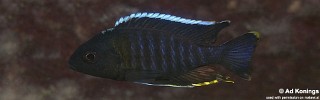
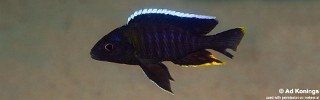
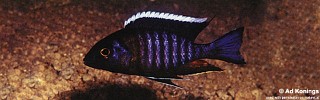
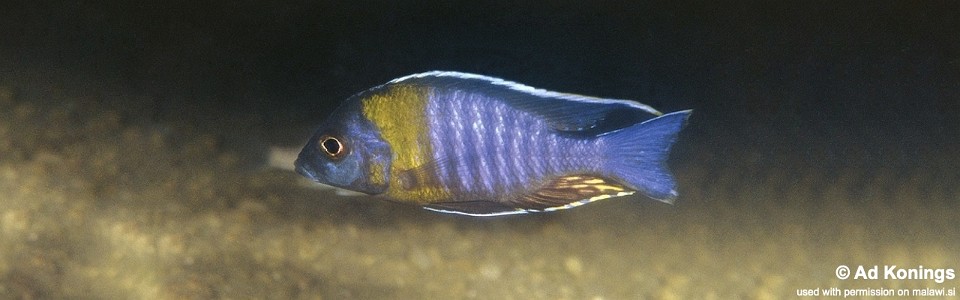




Photo gallery