Sandy habitats, often near Vallisneria beds.
Occasionally occurs in intermediate habitat with scattered rocks.
Mostly observed at depths between 15 and 30 m, but may occur shallower.
Geographic distribution:
Southern half of Lake Malawi, with confirmed records from the southeastern arm
and no reliable records north of Chizumulu Island.
Typical adult size:
Males up to 35 cm, females up to about 27 cm
Sexual dimorphism:
Strongly dimorphic.
Males develop a blue head, orange flanks, yellow dorsal fin with orange margin
and black pelvic fins.
Females are yellowish-silvery with a dark diagonal stripe and yellow fins.
Recommended aquarium size:
At least 1000 L
Aquarium setup:
Very large aquarium (minimum length around 250 cm).
Extensive open sandy areas with a few scattered rocks.
Vallisneria can be added but is optional.
Emphasis on swimming space rather than structure.
Diet:
Piscivorous predator feeding mainly on smaller sand-dwelling cichlids.
Breeding:
Maternal mouthbrooder.
Males defend temporary spawning sites over sand or rubble.
Spawning occurs directly on the substrate without bower construction.
Aggression:
Generally calm toward similarly sized fishes.
Smaller species are regarded as prey.
Territorial during breeding.
Special notes:
Large sand-dwelling predator often confused with
Buccochromis nototaenia.
Best kept only in very large aquaria with robust tankmates.
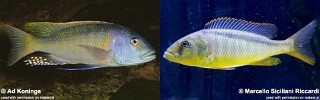
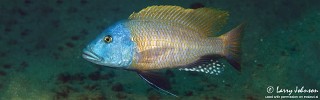
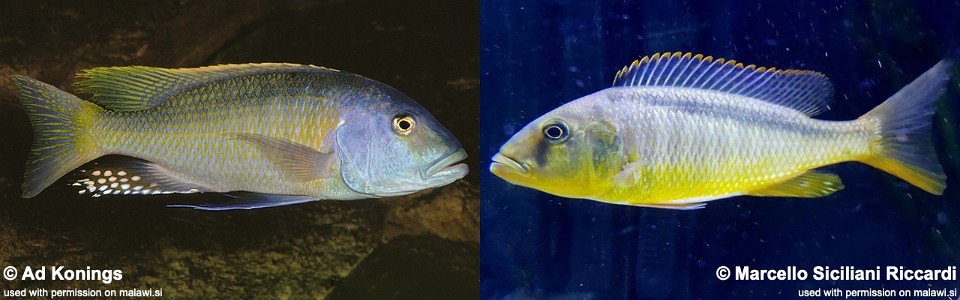




Photo gallery