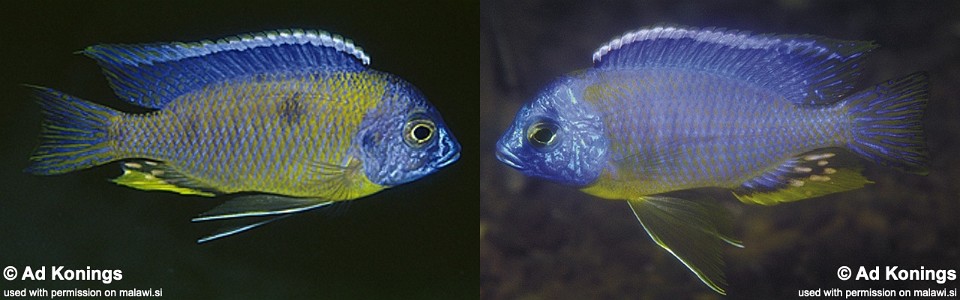

Intermediate habitat (sand–rock interface), typically at depths of about 7–19 m; females often school 1–2 m above the bottom while territorial males remain close to rocks and sand
Geographic distribution:
Endemic to the Mbenji Islands in the southern part of Lake Malawi
Typical adult size:
Males up to about 13 cm in the lake (up to ~15 cm in aquarium); females about 11 cm
Sexual dimorphism:
Females and juveniles are silvery with three black spots (supra-pectoral, supra-anal, caudal). Breeding males have a blue head, white throat with grey patches, light-blue flanks with orange suffusion, a yellow breast, and a dorsal fin with white lappets and yellow tips; the anal fin is blue/black proximally and yellow distally with white ocelli
Recommended aquarium size:
Minimum 300 litres; aquarium length at least 150 cm
Aquarium setup:
Fine sand substrate with a few rocks/stone structures; provide large open swimming areas and enough sand for bower construction against a rock. Keep as a pair or one male with several females
Diet:
Feeds on zooplankton and other planktonic items in the water column and also takes benthic invertebrates close to the substrate
Breeding:
Maternal mouthbrooder. Males construct a bowl-shaped sand bower beneath and/or adjacent to a rock; a small cave under the rock is used as the spawning site. Females brood for about 21 days and typically produce about 20–40 fry; fry are not guarded after release
Aggression:
Moderately territorial; males defend spawning sites and can be strongly territorial during breeding, but overall best kept with calm species
Special notes:
Member of the Copadichromis mbenjii group. Distinguished by three lateral spots and a supra-pectoral spot about 2–2.5 times the supra-anal spot; breeding males show a yellow breast and a wide yellow marginal band in the anal fin. Avoid tankmates with very similar male breeding coloration (e.g. some C. borleyi or C. trimaculatus variants).
Photo gallery