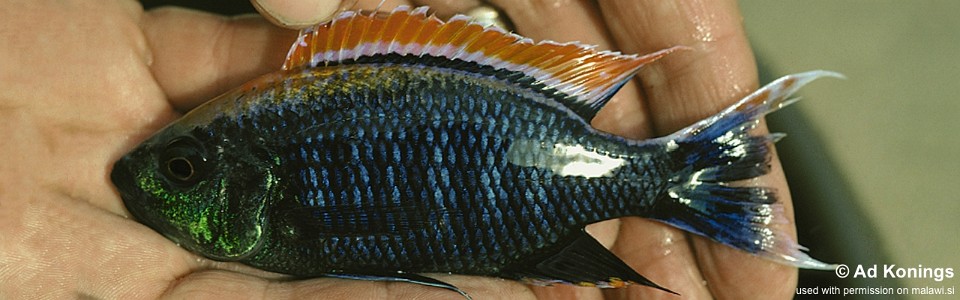

Open water; typically recorded at depths greater than 30 m, associated with the sand/rock interface near Gome.
Geographic distribution:
Lake Malawi; reported mainly from the Gome area.
Typical adult size:
Males up to 19 cm; females about 14 cm.
Sexual dimorphism:
Males are blue-black with a pale (white-blue) blaze running from the head toward the caudal fin; dorsal fin shows blue/white/orange; anal fin has egg spots. Females and juveniles are silvery.
Recommended aquarium size:
Minimum 300 litres; aquarium length at least 120 cm.
Aquarium setup:
Emphasise open swimming space. Fine sand substrate with a large sandy foreground, interrupted by a few larger rocks; keep broad sandy gaps between rocks.
Diet:
Plankton feeder in open water; has a strongly protrusible mouth adapted for capturing plankton.
Breeding:
Maternal mouthbrooder. Males build a sand crater/bower (reported from deep water) and court females there. Reported breeding season in the lake is August–November. Female incubation about 21 days; reported brood size about 20–30 fry. In the lake, males and females are said to be largely separate outside the breeding period.
Aggression:
Can be mildly aggressive within the species; otherwise a relatively peaceful utaka. Suggested harem ratio is 1 male to 2–3 females; can also be kept in larger groups provided each male has 2–3 females.
Special notes:
Reportedly not observed in the lake since around 1990; hypotheses mentioned include heavy fishing pressure or retreat to even deeper water.
Photo gallery