Nkhata Bay and Likoma Island, Lake Malawi, Malawi.
Biotope:
Open water and rocky habitats. Most commonly found at depths around 30 m.
Geographic distribution:
Widely distributed throughout Lake Malawi.
Typical adult size:
Males up to about 23 cm, females up to about 21 cm.
Sexual dimorphism:
Males have a yellow body with a blue head, a white edging on the dorsal fin,
and three black body spots. Females and juveniles are silvery with yellowish fins
and also show three black spots.
Recommended aquarium size:
Large aquaria recommended; at least 700 L due to adult size and active swimming behaviour.
Aquarium setup:
Spacious aquarium with extensive open swimming areas, fine sandy substrate,
and some rock structures and caves. Best kept with a single male and multiple females.
Diet:
Planktivorous. Feeds mainly on phytoplankton; often forms large schools while feeding.
Possesses an intestinal tract 2–3 times longer than most other utaka, adapted to this diet.
Breeding:
Maternal mouthbrooder. Males defend a rocky ledge at depths of approximately 25–30 m.
Spawning season in the lake occurs from August to December.
Females brood eggs for about 21 days and guard fry after they become free-swimming.
Aggression:
Generally peaceful but territorial during breeding; males defend spawning sites.
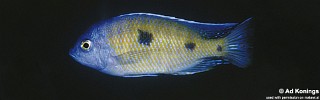
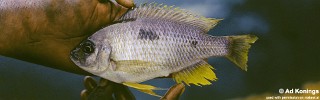
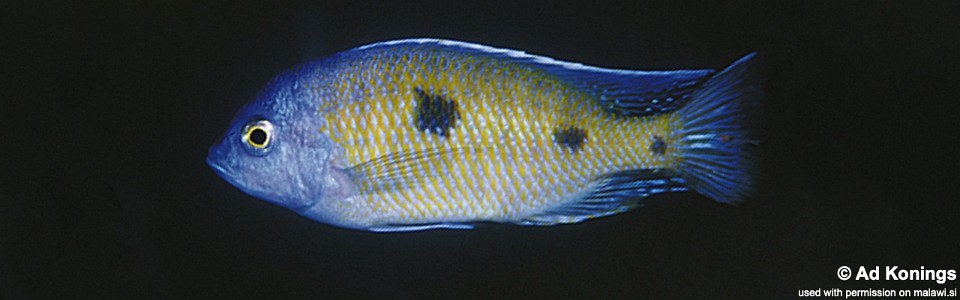




Photo gallery