Open water close to intermediate habitats. During breeding season the species
moves towards rocky shorelines, where large bowl-shaped nests are built in sand,
often adjacent to rocks or rock overhangs.
Geographic distribution:
Widespread throughout Lake Malawi.
Typical adult size:
Males up to about 20 cm, females up to about 14 cm.
Sexual dimorphism:
Females are uniformly silver-grey. Subdominant males are dark grey to black with
a green opercular spot and a yellowish frontal blaze. Dominant males are entirely
black with a very pronounced frontal blaze starting at the mouth and extending
along the dorsal fin; the dorsal fin has a black base followed by a white margin.
Recommended aquarium size:
At least 500 liters; large aquariums are required if multiple males are kept.
Aquarium setup:
Large aquarium with extensive open sandy areas for swimming, interrupted by
scattered larger rocks kept low to preserve open space. Fine sand substrate is
essential for nest construction.
Diet:
Carnivorous. Feeds mainly on phyto- and zooplankton captured in open water.
Breeding:
Maternal mouthbrooder. Males construct large bowl-shaped sand nests near rocks.
Females brood eggs for approximately 21 days. Successful spawning appears to
require the presence of multiple males, which leads to intense territorial
interactions.
Aggression:
Mildly aggressive within the species; generally peaceful towards other species.
Territorial interactions between males can be intense.
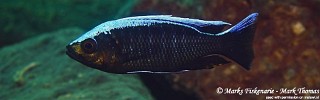
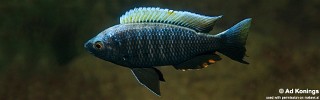
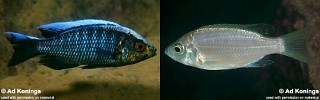
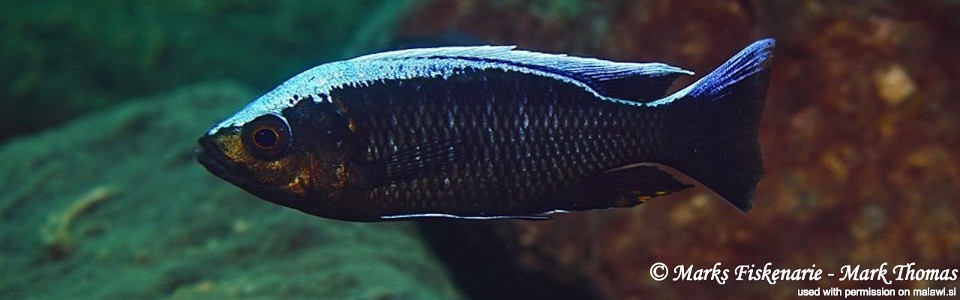




Photo gallery