Quiet, well-vegetated waters including lake margins, river margins and backwaters,
floodplains, swamps and vegetated shallow areas.
Geographic distribution:
Widely distributed in southern and central Africa. Native to river systems and
lakes including the Shaba, Upper Kasaï, Lualaba, Congo basin, Zambezi system,
Cunene, and coastal rivers to the Phongolo. Occurs naturally in Lakes Malawi,
Tanganyika, Chilwa, Chiuta and the Shire River. Native to Angola, Botswana,
Democratic Republic of the Congo, Malawi, Mozambique, Namibia, Eswatini,
Tanzania, South Africa, Zambia and Zimbabwe.
Typical adult size:
Up to 25 cm total length.
Sexual dimorphism:
Sexes are similar in appearance. Immature specimens may show a slightly reddish
chin and belly.
Recommended aquarium size:
Large aquariums are required due to adult size and territorial breeding behavior;
very spacious setups are recommended.
Aquarium setup:
Aquarium with extensive shallow areas, dense vegetation, open swimming space,
and firm substrates including rocks for spawning. Calm water flow is preferred.
Diet:
Primarily herbivorous, feeding mainly on aquatic plants and algae. Also consumes
aquatic invertebrates and occasionally small fish.
Breeding:
Biparental, monogamous substrate spawner. Breeding pairs clear vegetation in
shallow water to form large nests (0.5–1.2 m in diameter). Eggs are laid on rocks
and guarded by both parents. Larvae are placed in dug pits and tunnels until free
swimming. Parents actively guard and guide the fry. This is the only cichlid in
Lake Malawi that is not a maternal mouthbrooder.
Aggression:
Strongly territorial during breeding; otherwise relatively tolerant. Both parents
aggressively defend the spawning territory and fry.
Special notes:
Extremely tolerant species, capable of surviving temperatures from 11–37 °C and
salinity up to 19 ppt. Widely introduced outside its native range. One of the most ecologically distinctive
cichlids in Lake Malawi due to its biparental breeding strategy.
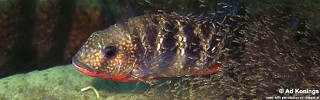
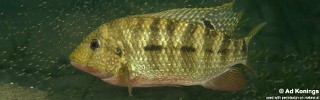
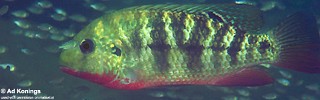
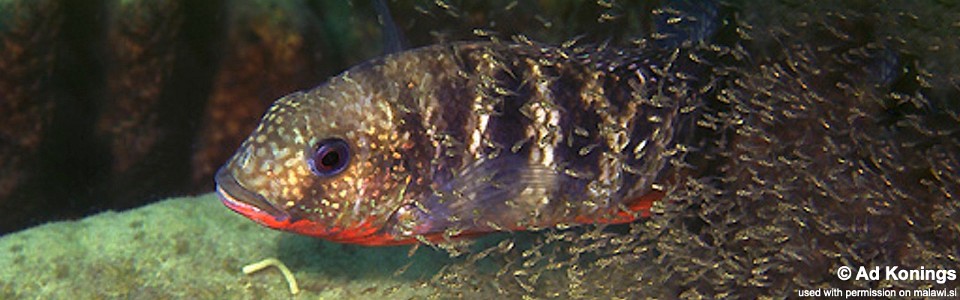




Photo gallery