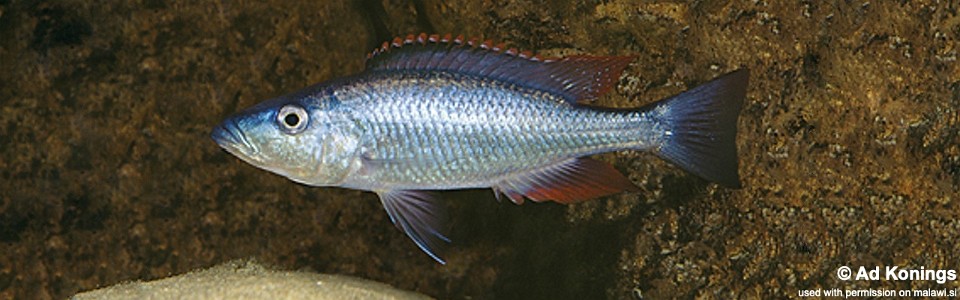

Very shallow sandy bottoms near the shoreline, often with vegetation; observed at depths up to about 3 m.
Geographic distribution:
Endemic to Lake Malawi; more common in the northern part of the lake, with only infrequent records from the south
(e.g. Kambiri Point).
Typical adult size:
Males up to about 20 cm total length; females remain smaller.
Sexual dimorphism:
Males are larger than females. Both sexes are silvery with a sharply defined mid-lateral stripe ending in an elongate
spot on the caudal fin; breeding coloration differences are subtle compared to other Dimidiochromis.
Recommended aquarium size:
Minimum 500–600 litres; large footprint preferred.
Aquarium setup:
Fine sandy substrate with some vegetated areas; limited rockwork. Provide ample swimming space.
Keep no more than one adult male per aquarium due to territorial behavior.
Diet:
Carnivorous; feeds on small fishes and larger invertebrates.
Breeding:
Maternal mouthbrooder. Breeding males have been observed but territorial behavior and spawning-site construction
are poorly documented; little is known about natural breeding behavior.
Aggression:
Generally shy in the wild; males can be territorial in the aquarium. Not suitable with very small tankmates due to
predatory tendencies.
Special notes:
Distinguished from other Dimidiochromis by its shallow body, relatively short dorsal spines, and a sharply demarcated
mid-lateral band terminating in a large elongate caudal spot. Although assessed as Least Concern (LC), it is rarely
encountered and likely affected by beach seining. Very shy and difficult to collect alive.
Photo gallery