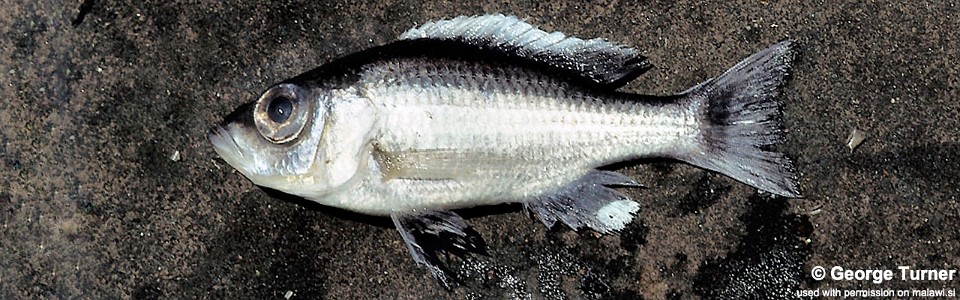

Off Monkey Bay, Lake Malawi, at approximately 100 m depth
Biotope:
Deep-water benthic to midwater environments over muddy bottoms,
typically at depths of about 80–130 m
Geographic distribution:
Southern arms of Lake Malawi; reliably documented from deep-water trawl
catches in the southern basin
Typical adult size:
Up to about 117 mm SL; approximately 14 cm total length
Sexual dimorphism:
Pronounced in breeding condition. Males develop a strongly contrasting
black-and-white pattern with a pale ventral surface and a broad white
margin on the dorsal fin; pelvic fins black and anal fin dark with one
or two pale yellow egg spots. Females and juveniles are silvery,
countershaded, and lack egg spots; female pelvic fins are shorter and do
not reach the vent
Diet:
Unknown in detail; morphology (steeply angled gape and long gill rakers)
suggests feeding on small midwater prey such as planktonic invertebrates
or fish larvae
Breeding:
Maternal mouthbrooder. Breeding likely occurs in deep benthic habitats;
females carry small broods of relatively large eggs. Reproductively
active individuals have been collected throughout much of the year,
suggesting a broad breeding season
Special notes:
A small-bodied, large-eyed deep-water species of Diplotaxodon.
Historically confused with D. ecclesi, but now regarded as
distinct based on consistent differences in size, meristics, and male
breeding coloration. Larger, similar-looking fishes from elsewhere in
the lake are treated separately as Diplotaxodon sp. ‘offshore’
Photo gallery