Domira Bay, northwest of Mbenji Island, Lake Malawi
Biotope:
Offshore deep-water habitats close to the lake floor, typically at about 70–145 m
depth, with mud-covered bottom in the deeper zone.
Geographic distribution:
Offshore in Lake Malawi; reported as lake-wide but rare compared with
D.limnothrissa, D.macrops, and
D.argenteus.
Typical adult size:
Type specimens range from 117.3–180.5 mm SL; reported maximum at least
203 mm SL (about 24 cm total length).
Sexual dimorphism:
Males have two pale yellow ocelli on the anal fin. Females and immature individuals
are uniformly silvery and countershaded, lacking vertical bars, horizontal stripes, and
flank spots.
Aquarium setup:
A deep-water offshore species associated with near-bottom habitats; it has never been
kept in the aquarium.
Diet:
An offshore piscivore.
Breeding:
Maternal mouthbrooder.
Special notes:
Whole-genome phylogenetic analyses resolve it as a genetically distinct lineage and
place it as sister to a clade comprising Diplotaxodon greenwoodi and
Pallidochromis tokolosh, with this group forming the sister lineage to
Diplotaxodon apogon.
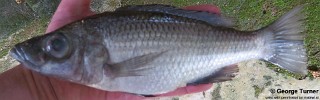
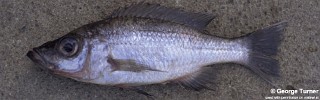
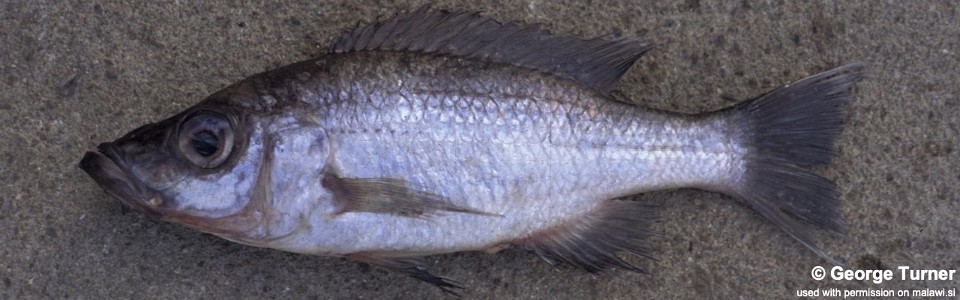




Photo gallery