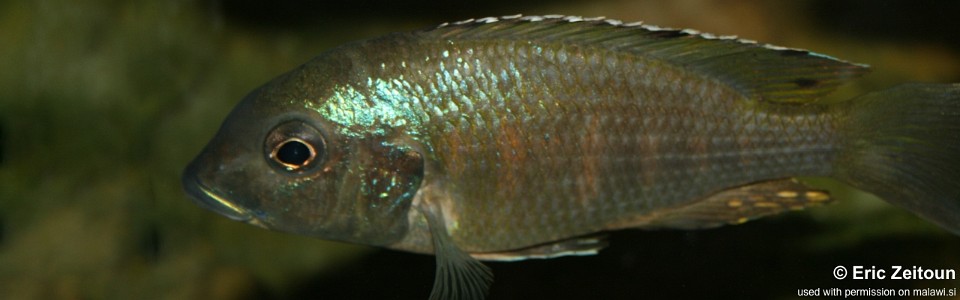

Very probably sandy habitats.
The presumed habitat is inferred from
dull brown coloration typical of
sand-dwelling species, but no direct
habitat data are available.
Geographic distribution:
Unknown.
The only known specimen was imported
from Tanzania together with fishes
collected at several localities.
Typical adult size:
The only known specimen was about 12 cm TL
when imported and reached approximately
15 cm TL in the aquarium.
Sexual dimorphism:
Females unknown.
Females are presumed to be smaller,
with shorter and less colourful fins
and lacking the blue hue on the head.
Diet:
Unknown in the wild.
In the aquarium readily accepts all
types of food and is probably at least
partially detritivorous, similar to
many sand-dwelling Lethrinops and
Placidochromis species.
Breeding:
Unknown.
Almost certainly a maternal
mouth-brooder, as are all advanced
haplochromine cichlids.
Special notes:
Known from a single living specimen.
Distinguished by deep brown base
coloration and absence of enlarged
sensory pores on the head, separating
it from sand-dwelling Aulonocara.
Behaviour and overall stance differ
from typical Lethrinops and suggest
possible affinity with sand-dwelling
Placidochromis lineages.
Its closest possible relative is
Placidochromis sp. ‘chinyankwazi’,
from which it differs by geographic
origin, darker coloration, fewer
vertical bars and shorter fins.
Photo gallery