Primarily associated with the intermediate habitat and sediment-rich rocky areas,
including shallow rocky zones with sediment; it is not reported from purely rocky
reef/islet environments. Habitats are described from about 15–30 m, while
mouthbrooding females are often seen in shallower water around 5–10 m.
Geographic distribution:
Occurs around Lake Malawi on the littoral; described as lake-wide in
sediment-influenced rocky habitats.
Typical adult size:
Up to about 35 cm total length; females are commonly around 24 cm,
with very large females exceeding 30 cm reported as rare.
Sexual dimorphism:
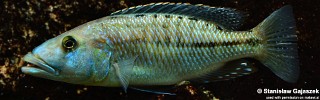
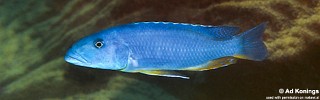
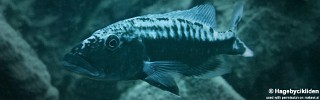
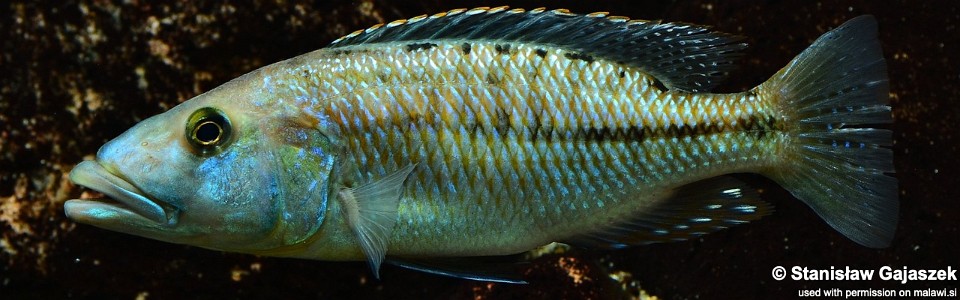
Females and non-breeding males are described as yellowish-silvery, often with a
dark lower half of the body. Breeding males are light blue with a yellow belly,
making them readily separable from females.
Recommended aquarium size:
An aquarium volume of at least 1000 L with a minimum tank length of
250 cm is recommended.
Aquarium setup:
Provide extensive open swimming space and structure typical of a rocky
transition/intermediate zone, with rockwork and a sandy front area. Avoid keeping with
Mbuna, Aulonocara, or any fish small enough to be swallowed; robust large
non-mbuna/utaka or other large predators are described as more suitable
companions.
Diet:
A piscivore that ambushes fish, including adult Mbuna and half-grown
haplochromine cichlids. The hunting sequence is described as adopting a
head-down posture (around 45°) while tilted to one side, focusing on prey with
one eye, then sliding closer and striking with a sudden sideways dash; the species
is also noted for its dark-bellied “reversed” coloration.
Breeding:
A maternal mouthbrooder. Males are described as non-territorial outside the
breeding period, but holding territories during breeding; spawning sites are built
against or between small rocks and described as a relatively small crater-shaped
pit (about 30 cm) or as a semi-circular sand wall/spawning dish against a
rock (around 50 cm). Females are reported to brood for about
3 weeks, and fry-caring females may continue to shelter fry in the mouth for
5–6 weeks after release; fry are noted around 3.5 cm by that stage.
Single territorial males are described rather than dense breeding colonies.
Aggression:
Characterized as a calm, robust predator outside breeding, but males can defend
spawning sites very aggressively during the reproductive period. Predatory risk to
smaller tankmates is emphasized, with guidance to avoid housing with fishes that
can be swallowed.
Special notes:
Distinguished from Tyrannochromis nigriventer by a longer premaxillary
pedicel, a straighter snout profile in subadults, and the reported absence of a tear
stripe; adults commonly show a black belly and a dark lower flank, while breeding
males are described as blue with a yellow belly (breeding males of
T. nigriventer are described as entirely blue). The species is described as
polymorphic in body shape.
Ad Konings and George Turner have argued that Tyrannochromis maculiceps and
Tyrannochromis polyodon represent the same biological species as
T. macrostoma and should be treated as junior synonyms; Turner also points
to weaknesses in earlier, museum-based attempts to separate these names, including
reliance on very limited material and confusion over how the name
nigriventer was applied relative to the black-bellied form. CAS (Catalog of
Fishes) also treats T. polyodon and T. maculiceps as synonyms of
T. macrostoma, while FishBase (fishbase.se) still lists T. polyodon
and T. maculiceps as valid species. On tanganyika.si, at least for now and
until it is demonstrated beyond doubt that these names refer to the same species,
we treat T. macrostoma, T. maculiceps, and T. polyodon as
valid species.
In aquarium-based observations, Jan Thoma reports recurring differences among forms
traded under these names: T. maculiceps is described as the most elongate
form with a very deep jaw, with a premaxillary pedicel described as longer than in
T. polyodon; adult individuals attributed to T. maculiceps are
reported to retain dark/black coloration beyond the juvenile stage, whereas in
T. macrostoma such dark coloration is described for females mainly as
juveniles. T. macrostoma is described as having a shorter snout and a
smaller mouth. T. polyodon is described as markedly deeper-bodied than
other Tyrannochromis forms and as having a jaw angle regarded as distinct.
Thoma also reports that when representatives of four named forms are kept together
they did not crossbreed, while noting that these statements are not supported by a
written dataset and are based on observations of imported and wild-caught
specimens.




Ad Konings and George Turner have argued that Tyrannochromis maculiceps and Tyrannochromis polyodon represent the same biological species as T. macrostoma and should be treated as junior synonyms; Turner also points to weaknesses in earlier, museum-based attempts to separate these names, including reliance on very limited material and confusion over how the name nigriventer was applied relative to the black-bellied form. CAS (Catalog of Fishes) also treats T. polyodon and T. maculiceps as synonyms of T. macrostoma, while FishBase (fishbase.se) still lists T. polyodon and T. maculiceps as valid species. On tanganyika.si, at least for now and until it is demonstrated beyond doubt that these names refer to the same species, we treat T. macrostoma, T. maculiceps, and T. polyodon as valid species.
In aquarium-based observations, Jan Thoma reports recurring differences among forms traded under these names: T. maculiceps is described as the most elongate form with a very deep jaw, with a premaxillary pedicel described as longer than in T. polyodon; adult individuals attributed to T. maculiceps are reported to retain dark/black coloration beyond the juvenile stage, whereas in T. macrostoma such dark coloration is described for females mainly as juveniles. T. macrostoma is described as having a shorter snout and a smaller mouth. T. polyodon is described as markedly deeper-bodied than other Tyrannochromis forms and as having a jaw angle regarded as distinct. Thoma also reports that when representatives of four named forms are kept together they did not crossbreed, while noting that these statements are not supported by a written dataset and are based on observations of imported and wild-caught specimens.
Photo gallery