Sediment-free rocky habitat, with adults more frequent below 10 m; it is also
associated with deeper rocky stretches, and sediment-free rocky areas tend to hold
denser populations than sediment-rich ones.
Geographic distribution:
Lake-wide in Lake Malawi, occurring as geographic variants that differ in the
strength of the basic pigmentation pattern; northern populations show much
stronger vertical elements than southern variants.
Typical adult size:
Males can reach about 30 cm, while females around 20 cm are regularly
observed.
Sexual dimorphism:
Breeding males are larger and show an overall dark blue body; the anal fin may be
orange and/or carry many orange spots, which can also appear on the caudal fin and
the soft part of the dorsal fin. Females are beige to silvery with the basic
melanin pattern clearly expressed; northern females commonly show strong, dark,
irregular vertical elements on the flank.
Recommended aquarium size:
An aquarium volume of at least 1000 L and a minimum tank length of 250 cm
are recommended.
Aquarium setup:
A layout described as a rocky “transition zone” is recommended, combining a
structured rocky back section with an open sandy foreground and several large
boulders, while preserving substantial free swimming space. To allow breeding,
provide enough open sand for construction of a large pit.
Diet:
Piscivorous, hunting mbuna by stealth among rocks and cracks; mbuna up to
6 cm have been recorded in stomach contents. In aquaria it is described as
adaptable to common prepared foods, including freeze-dried fish-based items, and
accepts foods such as smelt, mussel flesh, and shrimp.
Breeding:
Males hold territories only during the breeding season. Small breeding colonies
were observed at depths of about 30 m, 15 m, and 5 m, where each
male had built a crater-shaped spawning pit of roughly 1 m diameter against a
large boulder; elsewhere single breeding males were also seen, sometimes without
a pit. Eggs are reported to be fertilized inside the female’s mouth, and females
can guard fry for five to six weeks after first release, taking them back into the
mouth; by then fry may reach about 3.5 cm.
Aggression:
A large mbuna-eating predator; it ambushes prey from cover and may consume fish it
can swallow. Outside the breeding season it is described as non-territorial, but
breeding males can defend spawning sites strongly.
Special notes:
In the aquarium trade it is widely confused under the name “Haplochromis
Macrostoma”, and it is often sold as T. macrostoma. A practical field and aquarium
distinction is the premaxillary pedicel bulge on the snout: when the bulge lies
about halfway between the eye and the snout tip it indicates T. nigriventer,
whereas a position closer to the eye indicates T. macrostoma. In the lake,
individuals of T. nigriventer commonly show vertical bars and a tear stripe
between eye and upper lip, while a black belly is not typical.
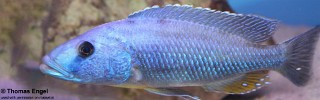
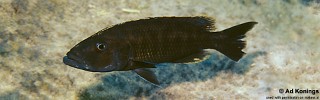
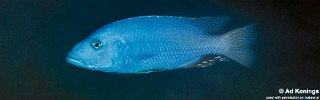
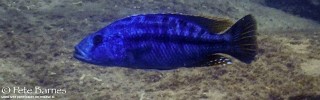
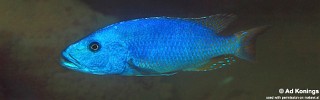
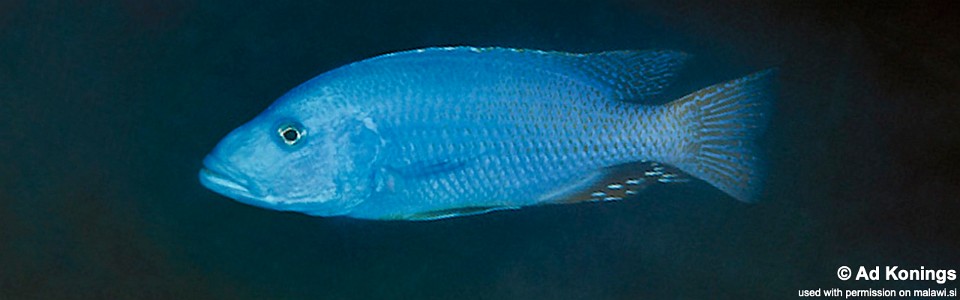




Photo gallery