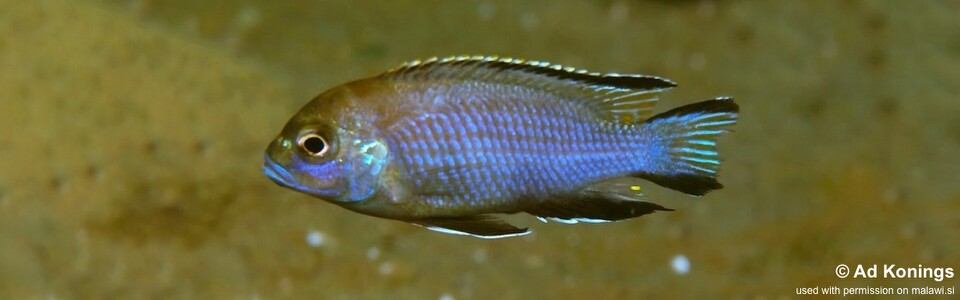

Sandy habitats associated with empty gastropod shells, typically near rocky structures
such as large boulders or sandstone slabs that provide additional shelter.
Geographic distribution:
Restricted to Gallireya Reef in Youngs Bay and Chitimba Bay in the northern part of
Lake Malawi.
Typical adult size:
Males about 7 cm, females about 6 cm (total length).
Sexual dimorphism:
Mature males develop a dark brown to blue overall coloration that obscures the flank
bar pattern, whereas females retain visible bars that extend onto the abdomen and
show a lighter ground coloration.
Recommended aquarium size:
250 L
Aquarium setup:
Fine sand substrate. Provide snail shells that are substantially larger than those used
for Tanganyikan shell-dwellers. Add plenty of rocks to create hiding places, and keep
as a harem (one male with several females).
Diet:
Omnivorous; feeds by combing loose algal material from shells and rocks and by picking
at small invertebrates. Females and juveniles also consume plankton in the water
column.
Breeding:
Females release the young into snail shells and typically do so earlier than many other mbuna,
often around day 13–15.
Aggression:
Generally peaceful toward other species, but males actively defend their shell-based
territories against conspecific intruders.
Special notes:
A true shell-dwelling mbuna with a strong association to empty gastropod shells.
Population density can be relatively high, and individuals are often observed in
groups near shell concentrations.
Photo gallery