Upper rocky habitat, usually free of sediment; some populations also occur in intermediate habitats where large schools hover above sand and rocks. Territorial males remain close to caves which they defend
Geographic distribution:
Northern rocky regions of Lake Malawi; present along the entire Tanzanian and Mozambican shoreline, southwards to Makanjila Point on the eastern shore and to the Mbenji Islands on the western shore. Introduced population around Thumbi West and Otter Islands in the southern lake
Typical adult size:
Males up to 10 cm in the lake (up to ~12 cm in aquarium); females about 8 cm
Sexual dimorphism:
Dominant males show strong black vertical bars on a light blue body; non-dominant males resemble females. Females are beige to grey-blue; mouthbrooding females may become very dark but never show a distinct barred pattern
Recommended aquarium size:
Minimum 250 litres
Aquarium setup:
Rocky layout with numerous hiding places and at least one small cave per male; provide open swimming space. Best kept as one male with 3–4 females; multiple males only if introduced together from the start in sufficiently large aquaria
Diet:
Omnivorous; mainly plankton feeder in the water column. Non-territorial individuals feed several meters above the rocks, while territorial males also graze aufwuchs and associated microorganisms near their caves
Breeding:
Maternal mouthbrooder; males defend caves among rocks where spawning takes place, females brood eggs and fry in the mouth and release them among the rocks
Aggression:
Highly aggressive, especially between males; aggression is primarily linked to territorial defence of caves and is also directed at similar-looking species
Special notes:
Characterized by black vertical bars on a blue body in males and unicuspid teeth. Shows considerable geographic variation in male coloration. Known to hybridize with Metriaclima zebra in introduced populations; avoid keeping with closely similar zebra-type mbuna in aquarium
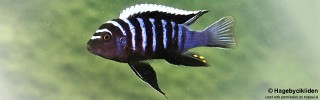
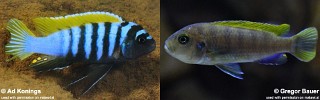
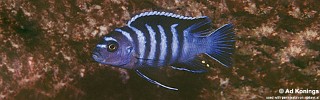
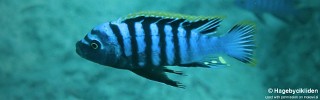
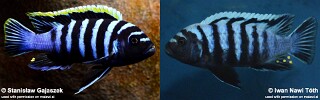
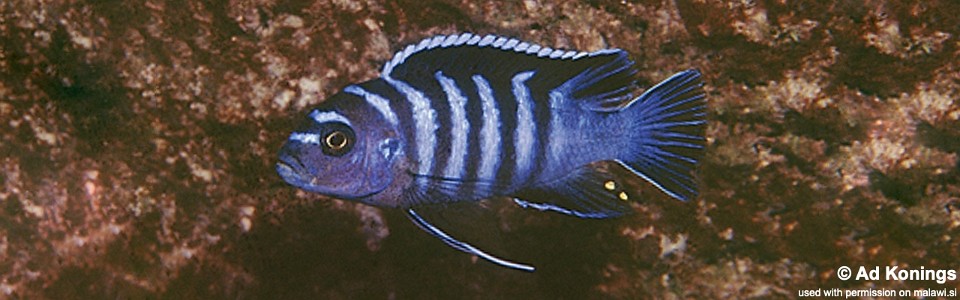




Photo gallery