Shallow intermediate habitat, typically around rocky areas with
crevices; type specimens were collected at about 10 m depth.
Geographic distribution:
Western coast from Chirwa Island to Ngara and eastern (Tanzanian)
coast from Manda to Nkanda in Lake Malawi.
Typical adult size:
Up to approximately 10–11 cm total length.
Sexual dimorphism:
Males are larger, more intensely blue and have longer fins than
females.
Aquarium setup:
Requires alkaline, moderately hard water at 23–26 °C with regular
maintenance. Both males and females defend feeding territories, so
sufficient rockwork and visual barriers should be provided.
Diet:
Herbivorous “dolphin mbuna” feeding on aufwuchs. The elongated,
narrow snout enables feeding from crevices, and algae are gripped
using the sides of the pointed jaws.
Breeding:
Maternal mouthbrooder. Males defend territories and spawning
occurs in caves. Incubation lasts about three weeks, after which the female releases the fry and
continues to guard them for a short period.
Aggression:
Intraspecific and interspecific aggression is pronounced, although
considered less aggressive than some closely related species.
Females also defend feeding territories.
Special notes:
Member of the “dolphin mbuna” group, characterized by an elongated,
beak-like snout. The species was previously known as
Pseudotropheus sp. ‘tursiops chitande’ and was
originally described under Melanochromis before being
reassigned to Pseudotropheus.
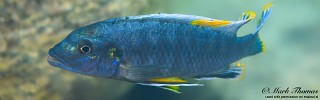
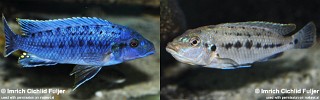
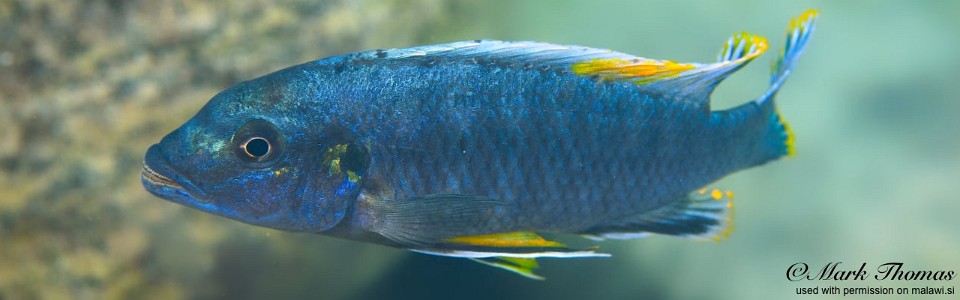




Photo gallery