Sediment-free rocky habitat, mainly within the upper three meters.
Typically hides in caves and crevices among rocks.
Geographic distribution:
Recorded around Chinyankwazi Island and Mumbo Island in southern
Lake Malawi.
Typical adult size:
Males attain about 15 cm total length; females remain approximately
3 cm smaller.
Sexual dimorphism:
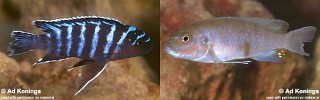
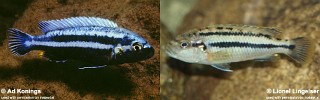
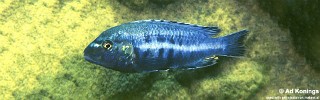
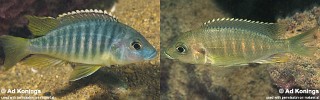
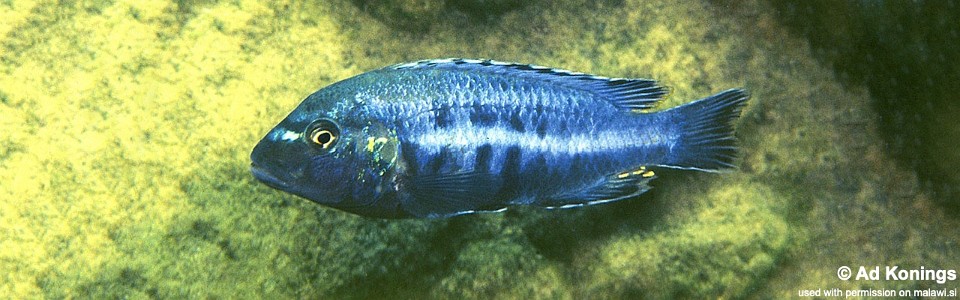
Territorial males are blue to dark blue with a solid light-blue
mid-lateral stripe and a less defined light-blue dorso-lateral stripe,
combined with dark vertical bars. Females are gray to green-yellow
with a solid black mid-lateral stripe and an interrupted black
dorso-lateral stripe.
Recommended aquarium size:
An aquarium volume of 500 L is recommended.
Diet:
Opportunistic omnivore. Feeds from the water column and is strongly
attracted to stirred-up material, particularly in wave-washed areas.
Stomach analyses have revealed insects, plankton, algae and other
available food items.
Breeding:
Males in breeding coloration defend caves and crevices as spawning
sites, with territories estimated at 2–3 meters in diameter.
Females are solitary and maternal mouthbrooders, remaining close
to the rocky substrate while brooding.
Aggression:
Strongly territorial during breeding. Males vigorously defend
spawning sites against conspecific males.
Special notes:
Distinguished from other species of the genus by breeding males that
simultaneously display horizontal light-blue stripes and dark vertical
bars. It is one of the largest members of the genus.
Johnson (1985) listed Chizumulu Island as the type locality, but since the specimen was acquired through the ornamental fish trade,
its exact origin is questionable. Given that similarly large individuals have only been encountered at Chinyankwazi Island, it is likely
that the original locality information was inaccurate. The proportions and coloration visible in the photograph of the living holotype
closely match wild males from Chinyankwazi Island, suggesting that this island represents the correct type locality.




Johnson (1985) listed Chizumulu Island as the type locality, but since the specimen was acquired through the ornamental fish trade, its exact origin is questionable. Given that similarly large individuals have only been encountered at Chinyankwazi Island, it is likely that the original locality information was inaccurate. The proportions and coloration visible in the photograph of the living holotype closely match wild males from Chinyankwazi Island, suggesting that this island represents the correct type locality.
Photo gallery