Rocky and intermediate habitats. Often associated with rocks but
frequently ventures over sand in the sand–rock interface zone.
Geographic distribution:
East coast of Lake Malawi between Makanjila Point (Malawi)
and Nkhungu Point (Mozambique).
Typical adult size:
Males attain about 11 cm total length; females remain
approximately one fifth smaller.
Sexual dimorphism:
Females are light coloured with an elongated body shape.
Breeding males resemble those of M. auratus and
M. mossambiquensis but have a longer snout and a
shallower body.
Recommended aquarium size:
An aquarium volume of 400 L is recommended.
Diet:
Predatory omnivore. Feeds close to the substrate from the
biocover and searches primarily for invertebrates rather
than grazing algae. Also attracted to stirred-up material.
Breeding:
Males in breeding coloration are infrequently observed and
territorial males have not been recorded in the wild.
Individuals are generally solitary and show aggression
only upon encountering rival males. Females are maternal
mouthbrooders and may be seen in small groups.
Aggression:
Moderate in the wild; males are aggressive toward
conspecific males when encountered. In aquaria males
become strongly territorial and should be kept singly.
Special notes:
An elongate species with a long snout and relatively
shallow body. Less common than sympatric
M. dialeptos and M. wochepa.
Often occurs at depths of 10–20 m and occasionally
deeper than 20 m. Specimens may appear washed out
after collection but regain full coloration under
stable aquarium conditions.
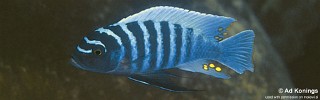
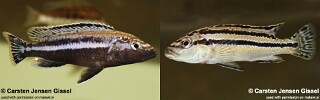
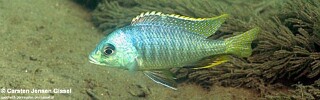
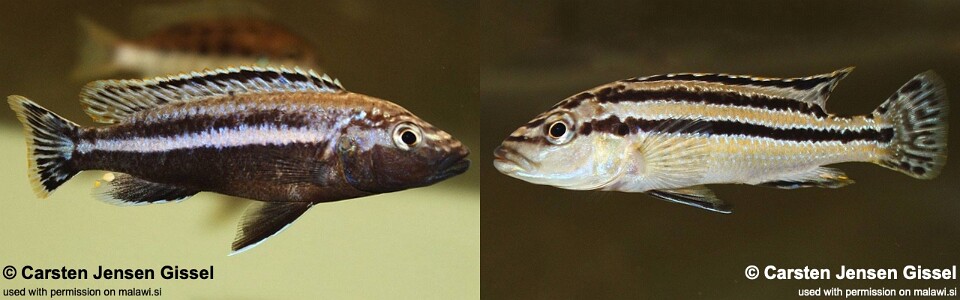




Photo gallery