Typically associated with clear water and sediment-free rocky habitats.
It is also recorded in intermediate biotopes that remain free
of muddy sediment.
Geographic distribution:
Recorded on the west coast from Ruarwe to Ngara, and along
the Tanzanian shoreline between Lupingu and Pombo Rocks.
Sexual dimorphism:
Males are largely light blue and do not show a black band
in the anal fin. Females are mainly yellow to yellow-white
and have orange anal fins.
Diet:
Grazes aufwuchs; feeding includes tearing filamentous algal
strands while shaking the body. Most species feed at roughly
a 60° angle to the substrate, while surf-zone forms feed
at about 45°.
Special notes:
Occurs sympatrically with Tropheops gracilior across much
of its range but differs in size and coloration. Similar
forms formerly included under this name were later separated
as Tropheops sp. ‘mauve yellow’, whose males display a black
band in the anal fin and whose females are described as
yellow. At Magunga (Tanzania), females corresponding to
entirely blue males were described as silvery and lacking
orange coloration in the anal fin.
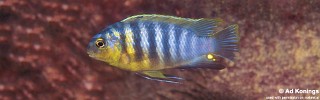
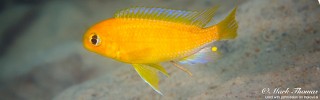
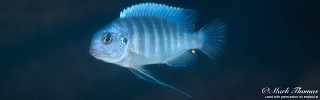
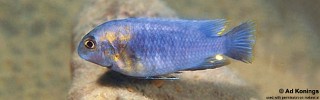
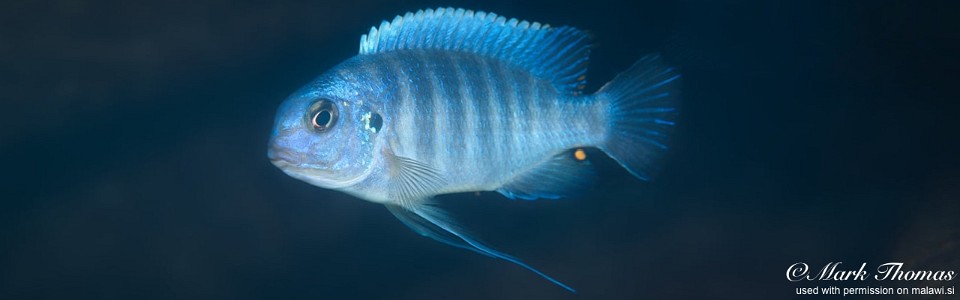




Photo gallery