Inhabits rocky habitat without significant sediment, occurring over rock substrates and
along rock–sand interfaces to depths of at least 12 m.
Geographic distribution:
Recorded from Matema to Kirondo along the eastern Tanzanian coast and from Mdoka to
Chirwa Island along the western Malawian coast; also reported from Chizumulu Island.
Typical adult size:
A medium-large species reaching approximately 11–13 cm total length.
Sexual dimorphism:
Males display a plain lemon-yellow coloration, usually with a single large anal ocellus,
longer fins and a broader anal egg-spot; females are pinkish to beige-yellow with dotted
fins and smaller ocelli.
Recommended aquarium size:
An aquarium volume of 300 L with a minimum tank length of 120 cm is recommended.
Aquarium setup:
Provide abundant rock structures and shelters forming territories and spawning sites.
Males defend relatively large areas for feeding and breeding.
Diet:
Primarily algivorous; feeds on aufwuchs by firmly grasping attached algae with closely
set teeth and shaking to detach it from the substrate. Plankton is also consumed.
Breeding:
Maternal mouthbrooder. Males excavate a pit beneath a stone and defend the spawning
territory; females incubate eggs and fry in the mouth for about three weeks before release.
Aggression:
Very aggressive toward conspecifics and other tank inhabitants. Males are highly
territorial and defend large feeding and spawning areas.
Special notes:
Characterized by a very high-bodied form, steep angular head profile and extremely
narrow mouth among the most specialized within the genus. Part of the so-called
“Midas mbuna” group of uniformly yellow species that show strong colour convergence
across genera, typically with a single large anal ocellus in males. Some populations
show variation in intensity of yellow coloration and anal fin patterning.
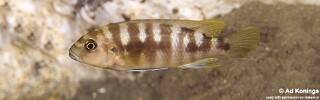
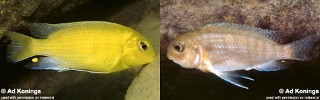
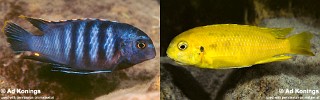
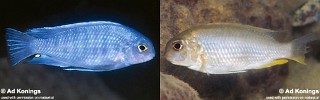
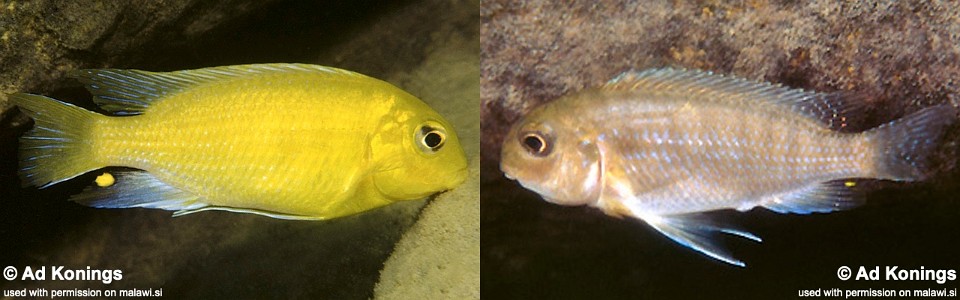




Photo gallery