Rocky transition zone and rocky habitat at depths of
10–40 m, where it utilizes both rock structures and adjacent
sandy areas.
Geographic distribution:
Lake Malawi, around the Nankhumba Peninsula in Malawi.
Typical adult size:
Males up to about 15 cm; females about
11–12 cm.
Sexual dimorphism:
Males are larger and blue with dark ventral and anal fins.
Females and juveniles are silvery.
Recommended aquarium size:
An aquarium volume of at least 400 L is recommended
for a species-only setup. In community settings with other Malawi
cichlids, 500 L or more should be considered.
Aquarium setup:
Provide large rock structures with visual barriers,
shaded areas, crevices and caves, combined with open sandy zones.
Fine-grained substrate is recommended.
Diet:
Carnivorous; feeds on small crustaceans and other small
invertebrates sifted from sediment. In the aquarium it requires
protein-rich food such as live or frozen fare, but accepts prepared
foods when sufficiently high in protein.
Breeding:
Maternal mouthbrooder. Females incubate the brood for a
little over three weeks and typically release 25–50 fry. Harem
structure with one male and several females is recommended in the
aquarium.
Aggression:
Generally not highly territorial. Males are moderately
territorial toward conspecific males.
Special notes:
Also known under earlier names such as
Otopharynx sp. 'blue otter' and
Haplochromis sp. 'domwe reef granderus'. Several populations
exist but show only minor variation.
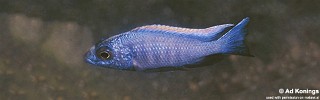

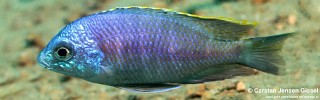
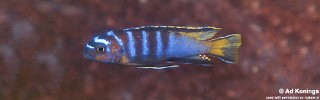
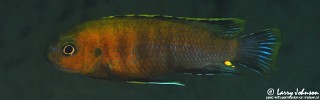
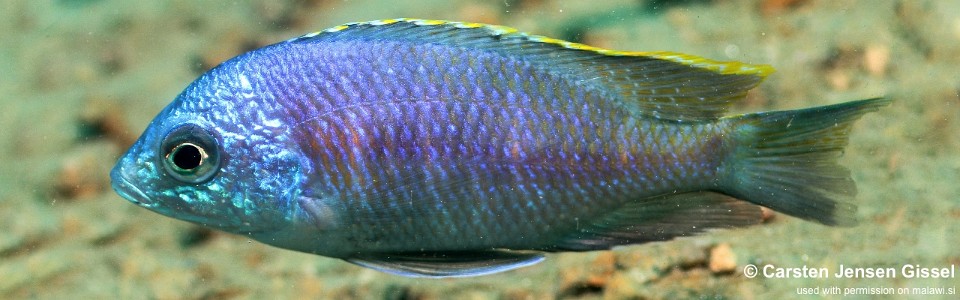




Photo gallery