Sediment-free rocky habitat at Gallireya Reef, with volcanic-like
rock formations; reef depth not exceeding about 12 m.
Geographic distribution:
Only known from Gallireya Reef near Hara Village, Lake Malawi
(Malawi).
Typical adult size:
Approximately 8–9 cm total length in males.
Sexual dimorphism:
Males are larger, with longer fins and a dominant coloration
ranging from mustard yellow to orange-brown; females are dark
brown with bold bars and an orange anal fin.
Recommended aquarium size:
An aquarium volume of at least 400 l is recommended to reduce
intraspecific aggression.
Aquarium setup:
Provide ample rock structure and keep in a spacious,
polyspecific community aquarium to mitigate aggression.
Diet:
Dentition suggests adaptation to algae scraping; external row of
bicuspid teeth followed by smaller tricuspid rows.
Breeding:
Maternal mouthbrooder; clutch size reported at about
10–15 eggs.
Aggression:
Not strictly territorial but shows strong intraspecific
aggression.
Special notes:
A distinctive small-to-medium mbuna with a prominent external row
of bicuspid teeth and smaller inner tricuspid rows. Males may show
a black spot in the soft-rayed portion of the dorsal fin and light
spots in the caudal fin. Although provisionally associated with the
Pseudotropheus perspicax complex, it differs markedly in size,
coloration, head morphology, and behavior. It shows some
resemblance to species of Tropheops and to
Pseudotropheus lucerna, but represents a distinct insular
form.


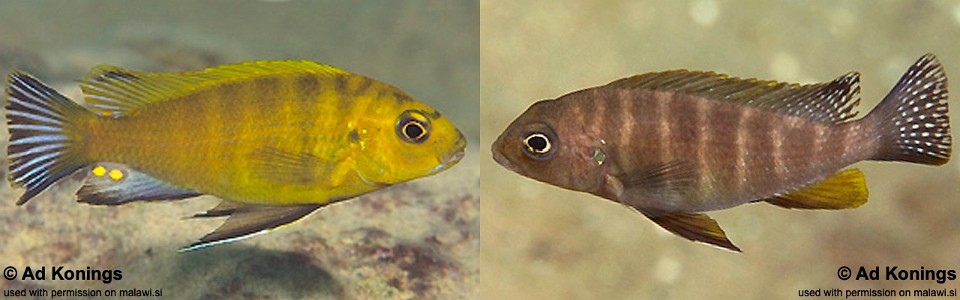




Photo gallery