Primarily over open sand, sometimes well away from rocks, but it may also forage among
rocks in intermediate habitats. It is encountered from a few meters depth down to about
40–50 m.
Geographic distribution:
Endemic to Lake Malawi, with multiple geographical populations. It is collected mainly
around Likoma Island; other populations occur along the Mozambique shoreline from Chiwindi
to Lumbaulo, at Mala Point, from Lumessi to the Malawi border, and south to Ntekete in
Malawi.
Typical adult size:
Wild males reach about 15 cm total length and females about 11 cm. In captivity,
males may reach about 18 cm total length.
Sexual dimorphism:
Both sexes show a conspicuous black cheek, formed by a dark bar running through the
eye and expanding over the cheek, gill cover, throat, and chin. Mature males become blue to
very dark blue overall, while females remain sand- to silver-toned and are readily
distinguished.
Recommended aquarium size:
A minimum tank length of about 150 cm is recommended, and more than 200 cm is
recommended if more than one adult male is kept.
Aquarium setup:
Provide ample open swimming space with fine sand as the substrate.
Diet:
An opportunistic feeder that takes items from the sand surface and is attracted to
stirred-up sediment, often foraging around sand-grubbing cichlids. In the aquarium it
accepts flakes and pellets; frozen invertebrates such as Artemia and Mysis help condition
adults.
Breeding:
Reports of territorial males in the wild are inconsistent, but males in full breeding
coloration are commonly observed. Spawning appears to occur wherever a receptive female is
encountered, and the female mouthbroods; an aquarium spawn from wild fish produced
70 eggs, with development to free-swimming fry taking about three weeks.
Aggression:
Generally not strongly aggressive toward other cichlids, but adult males can become
territorial in confined aquaria. Males may focus aggression on similarly colored species,
and females may pair with look-alike males, increasing hybridization risk.
Special notes:
It is identified by a strongly emphasized first vertical bar while the posterior bars
are faint in non-breeding fish, and by the absence of any horizontal stripe. The black cheek
is present in both sexes in breeding and non-breeding condition, and breeding males may
show stronger barring overall. A narrow white/yellow margin on the dorsal fin separates it
from the similar P. sp. ‘phenochilus gisseli’, whose dorsal fin lacks that margin.


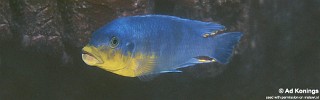
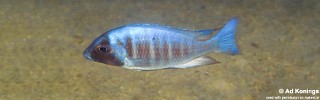
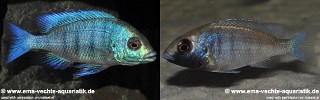
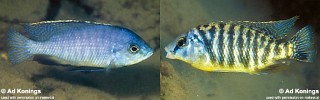
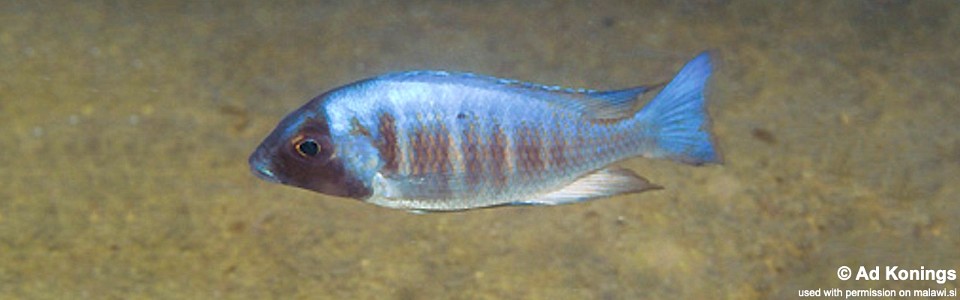



Photo gallery