Primarily sandy bottoms in shallow water; also recorded in rocky habitats,
where shelter among rocks may offer better protection.
Geographic distribution:
Recorded around Likoma Island, along the northern shores of Mozambique,
and south of Monkey Bay; regarded as having an almost lake-wide range.
Typical adult size:
In the wild, males reach about 14 cm total length, while females
attain about 11 cm. In the aquarium, they can grow to
16 cm or more.
Sexual dimorphism:
Sexes are difficult to distinguish by appearance; males are usually slightly
brighter and more contrasting. Adult sexing is possible by the genital pore,
which is clearly larger in females.
Recommended aquarium size:
A minimum tank length of 120 cm is recommended.
Aquarium setup:
Provide ample open bottom area with fine-grained sand. With sufficient space,
a group of 6–8 individuals can be maintained, including multiple males.
Diet:
Feeds by picking or scooping algae from sand and objects lying on sand.
In captivity, a good-quality flake food is suitable; frozen foods such as
krill, plankton, or Daphnia can be used especially for conditioning.
Breeding:
Maternal mouthbrooder. Can be bred in a community aquarium; a ratio of
three or more females per male is suggested, though breeding with a single
pair is also OK.
Aggression:
Males are described as not overly aggressive.
Special notes:
A true sand-dwelling mbuna that often forms schools over sand; small
individuals may use empty Lanistes nyassanus shells as shelter, but
adults are too large to fit. The species has been widely misapplied in the
literature and hobby, with “P. livingstonii” long used for a look-alike shell
associate; the fish circulating as “P. elegans” in the hobby has been identified
as the true P.livingstonii. Extended soft fin rays create
a trailing, undulating appearance when the fish moves, and both sexes show a
distinct black band in the anal fin.
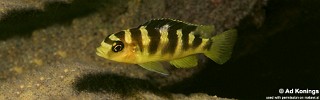
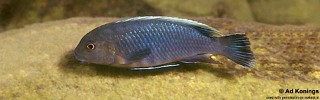
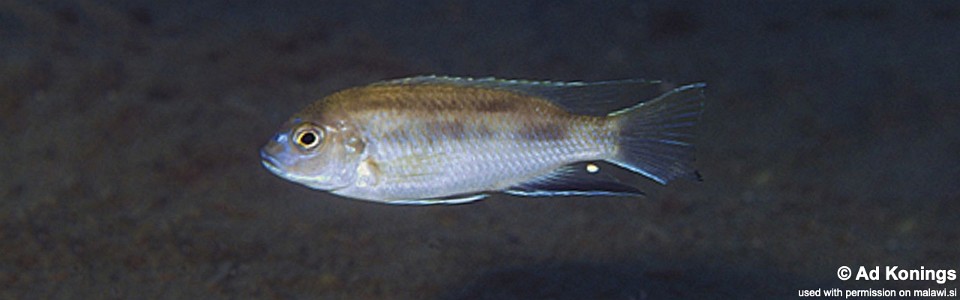




Photo gallery