Sediment-rich and intermediate habitats. It occurs among rocks of various sizes and
is often associated with intermediate zones that contain some rocks; reported depth use
includes shallow water (often not beyond 8 m), with records down to 18 m at Boadzulu
Island. Males may be most abundant around 3 m, while females are often most abundant in
the extreme shallows.
Geographic distribution:
Among the most widely distributed mbuna in Lake Malawi. Reported as widespread along
most of the western Malawian coast (up to Ruarwe) and at Makanjila on the eastern coast,
with records extending to the Tanzanian eastern coast at Londo where it coexists with
P. flaviventris. It is absent from a few known localities including Likoma,
Chizumulu, Chinyankwazi, and Chinyamwezi, and is encountered at many islands in the
western half of the lake.
Typical adult size:
Typically about 15 cm total length in adult males, with aquarium individuals reported
to become larger. In the provided husbandry note, adult size is given as 17 cm for males
and 14 cm for females.
Sexual dimorphism:
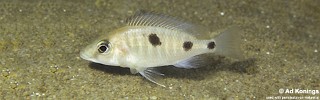
Males are larger and more colourful, with broader fins and larger egg spots on the
anal fin. Females (and juveniles) show a pale background (white to very light beige)
with two rows of spots on the flank, the lower row including a few larger blotches, and
the dorsal fin bears a black submarginal band.
Males are described as mainly blue-grey with yellow ventral areas (notably throat and
cheeks) and with thick black submarginal bands in the dorsal and anal fins; dominant
males may show stronger vertical barring.
Recommended aquarium size:
An aquarium volume of 500 L is recommended.
Diet:
Omnivorous with a strong reliance on grazing: it primarily brushes rock surfaces to
collect loose aufwuchs and associated invertebrate fauna, and also takes plankton when
it is abundant. Juveniles are reported to feed primarily on plankton. In aquarium care
notes, algae-based foods (e.g., spirulina or algae-based flakes/sticks) are suggested,
with caution advised against soft foods such as mosquito larvae, worms, or adult brine
shrimp due to long-term digestive issues.
Breeding:
Maternal mouthbrooder. The pair bond lasts only during spawning; eggs are taken into
the female’s mouth after fertilisation and incubated for about three weeks. Territorial
males defend breeding areas against conspecific males, with mean territory surface
reported around 20 m² (and breeding territories described as over 20 m² in some cases).
Aggression:
Aggressive mainly towards conspecifics: only a minority of males are territorial, and
territorial males primarily chase other males of the same species. It is described as
less aggressive than some other rock-dwelling cichlids and is generally tolerant toward
other species. It commonly forages in large schools, which may include a few other
Petrotilapia species.
Special notes:
A member of the habitat-related “P. genalutea group”, associated with
sediment-rich and intermediate habitats.
Recognizable by the black submarginal band in the dorsal fin and two rows of blotches
on the flanks. It commonly forms large feeding groups, especially when food resources
are limited.
A form previously referred to as P. sp. ‘chitande’ is discussed as a geographical
variant or closely related phenotype, and the species has also been exported under the
name “Petrotilapia Tridentiger”.

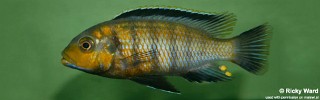
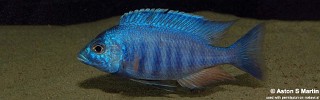
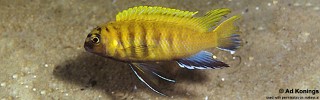
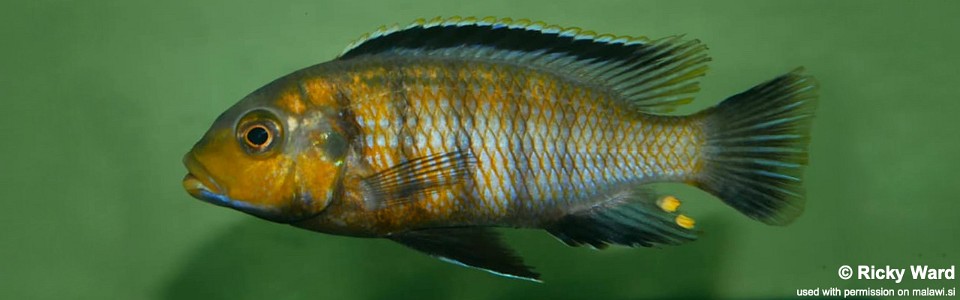




Males are described as mainly blue-grey with yellow ventral areas (notably throat and cheeks) and with thick black submarginal bands in the dorsal and anal fins; dominant males may show stronger vertical barring.
Recognizable by the black submarginal band in the dorsal fin and two rows of blotches on the flanks. It commonly forms large feeding groups, especially when food resources are limited.
A form previously referred to as P. sp. ‘chitande’ is discussed as a geographical variant or closely related phenotype, and the species has also been exported under the name “Petrotilapia Tridentiger”.
Photo gallery