Occurs in rocky and intermediate habitats, from shallow water down
to at least 35 m. Considered a species of deeper areas and rarely
recorded in water shallower than 10 m.
Geographic distribution:
Western coast of Lake Malawi from Hora Mhango to Mara Rocks,
and eastern coast from the Ruhuhu River (Tanzania) to
Lumbaulo (Mozambique).
Typical adult size:
Usually 9–11 cm TL in imports, growing larger in aquarium
conditions.
Sexual dimorphism:
Males are larger, with longer fins and larger anal ocelli. Males show
brown-red to ocher coloration with faint vertical barring, varying
to intense orange-yellow. Females are beige with a yellow to
lemon-yellow anal fin and a black submarginal band in the dorsal
fin, which may disappear in dominant males.
Recommended aquarium size:
An aquarium volume of around 300 L is suitable, and a minimum
tank length of about 1.5 m is required to maintain more than one
active male.
Aquarium setup:
Provide abundant shelters such as rocks, flat stones and similar
structures arranged over sandy patches to allow territory formation.
Diet:
Feeds primarily on aufwuchs and also takes food from substrate and
sediment layers deposited on rocks. In aquarium, a diet rich in
vegetable matter is required.
Breeding:
Maternal mouth-brooder. Males excavate a pit beneath a stone or
defend spawning sites between or alongside rocks. Courtship
involves displaying and quivering movements before leading the
female to the spawning site. Incubation lasts about 3 weeks.
Aggression:
Territorial but comparatively peaceful within the genus. Males defend
territories against conspecific males and may guard areas at the
base or surface of rocks.
Special notes:
Belongs to the romandi group. Despite the name “red fin”, the anal
fin of females is typically yellow to lemon-yellow. The provisional
name originated from early taxonomic confusion in mixed
material.
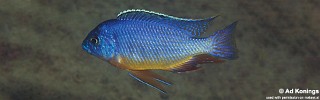
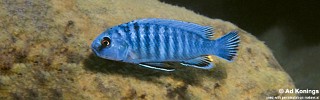
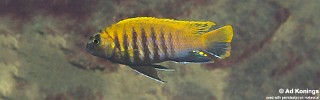
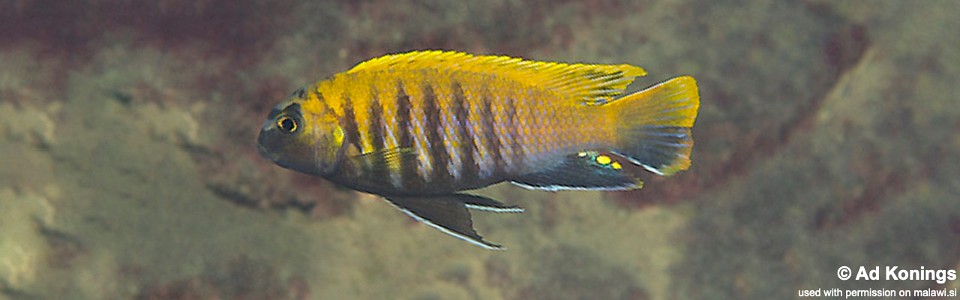




Photo gallery