Shallow sandy areas in the southeastern arm of Lake Malawi,
typically at depths of 5–15 m. Breeding males have been observed
defending sand craters and cave-crater bowers in intermediate habitats,
sometimes incorporating rocks into the spawning site.
Geographic distribution:
Recorded from Boadzulu Island, White Rock,
and Kancheza Island in the southeastern arm of the lake.
Typical adult size:
Males up to about 17 cm total length; females up to about
13 cm total length.
Sexual dimorphism:
Males in breeding coloration display a blue base color with
vertical barring and a distinct horizontal mid-lateral stripe extending
toward the caudal peduncle. A whitish to light-blue blaze is present on
the head and continues as a pale marginal band in the dorsal fin.
Females and juveniles are predominantly silvery.
Recommended aquarium size:
A minimum tank length of 130 cm and a volume of
400 l are recommended.
Aquarium setup:
An aquarium with ample open swimming space and fine sandy
substrate is suitable. A few rock structures may be included.
Can be maintained as a pair or in a group
consisting of one male and several females.
Diet:
Feeds on zooplankton captured in open water. The species has
a protrusible mouth adapted for suction feeding.
Breeding:
Males construct large sand craters on open sandy bottoms and
court females with display behavior. Spawning occurs at the prepared
site. The species is a maternal mouthbrooder; females incubate the eggs
for approximately 21 days and produce broods of about 30–50 fry.
In the wild, juveniles are often observed swimming in groups.
Aggression:
Territorial during breeding, with males defending their
constructed bowers.
Special notes:
Belongs to the utaka group and is characterized by a
distinct horizontal mid-lateral stripe. The name “boadzulu” has often
been incorrectly applied to Protomelas taeniolatus from
Namalenje Island. The true N. boadzulu is considered rare and
forms small populations in sandy habitats of the southeastern arm of
the lake.
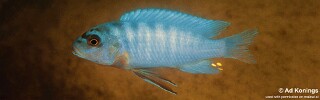
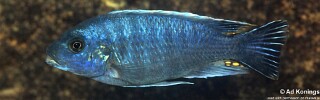

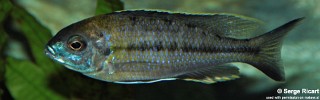
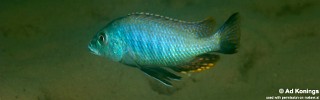
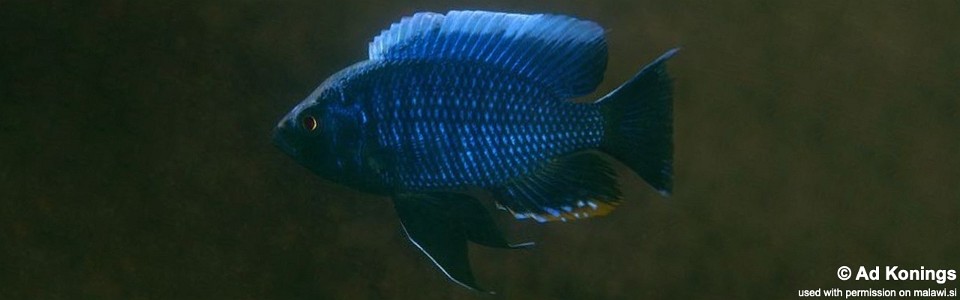




Photo gallery