Inhabits rocky habitat among small and medium-sized rocks at depths from 3 m to at least
40 m.
Geographic distribution:
Reported from the southern end of Lake Malawi along the Nankumba Peninsula, from Domwe
Island to Chemwezi Rocks.
Typical adult size:
A rather small species reaching about 9 cm total length in the wild and up to
11 cm in aquarium.
Sexual dimorphism:
Males are larger and display a sky-blue ground coloration with rather faint vertical barring,
mostly on the anterior part of the body; females remain greyish and show shorter fins and
smaller anal ocelli.
Recommended aquarium size:
An aquarium volume of 300 L with a minimum tank length of 120 cm is recommended.
Aquarium setup:
Provide abundant rock structures forming shelters over sandy areas. Avoid
closely related species to reduce hybridization and territorial competition.
Diet:
Feeds by nipping aufwuchs from rocks and also catches plankton in the water column.
Breeding:
Maternal mouthbrooder. Males excavate a pit beneath a stone and defend the spawning site.
Females incubate eggs and fry in the mouth for about three weeks before release.
Aggression:
Males are weakly territorial; females are not territorial. Intraspecific aggression may occur,
but the species is regarded as relatively peaceful among mbuna.
Special notes:
Belongs to a group of slender mbuna with a distinctly down-turned mouth adapted for grazing
on rock surfaces while maintaining a low body angle.
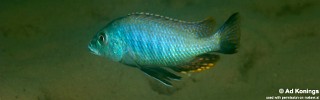
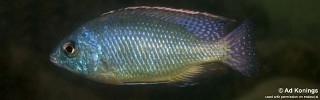
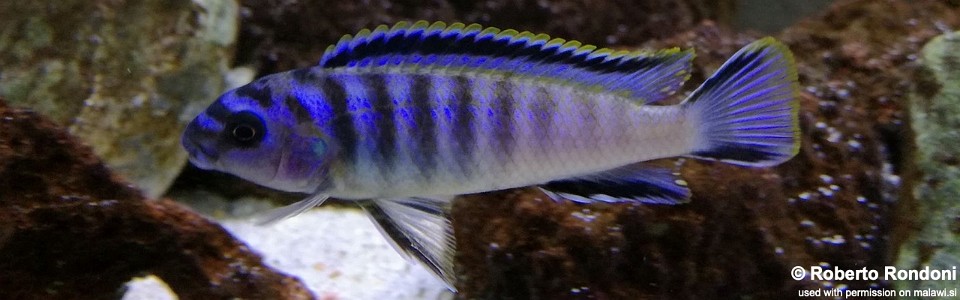




Photo gallery