Rocky and intermediate habitats. Most frequently observed at depths of
20–40 m, but locally recorded as shallow as about 7 m.
Geographic distribution:
Northern Lake Malawi. Recorded along the northwestern shore between
Chitande Island and Nkhata Bay, and along the
northeastern shore between Matema and Hongi Island near Liuli.
Sympatric with M. kaskazini along parts of the Tanzanian coast.
Typical adult size:
Males attain approximately 14–15 cm total length; females rarely exceed
about 10 cm.
Sexual dimorphism:
Breeding males are uniform cyan to light blue without visible bars or
stripes on the flank and show a pale-blue distal margin in the dorsal fin.
Females and non-breeding males are brown to dark brown with a melanin
pattern consisting of two horizontal stripes combined with vertical bars.
Recommended aquarium size:
An aquarium volume of 500 L is recommended.
Diet:
Predatory omnivore. Feeds on small fishes (fry), benthic crustaceans,
insect larvae and other invertebrates, and occasionally plankton.
Individuals are opportunistic and may form small hunting packs when
prey opportunities arise. Attracted to disturbed sediment.
Breeding:
Territorial males have not been observed in the wild. Courtship occurs
opportunistically when males encounter receptive females. Females are
maternal mouthbrooders and remain solitary during brooding. Brooding
females are sometimes encountered in shallower water.
Aggression:
Generally solitary but capable of forming temporary hunting groups.
In the aquarium males are highly territorial and should be kept singly.
Special notes:
Distinguished from M. melanopterus by the presence of vertical bars
in females and non-breeding males. Fully coloured males closely resemble
those of M. kaskazini, but juveniles and females differ markedly in
basic melanin pattern. The species is uncommon in most areas, usually
encountered singly or in small numbers.
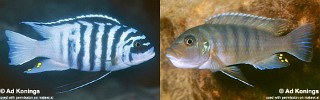
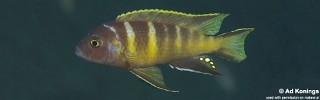
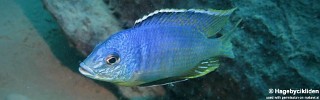
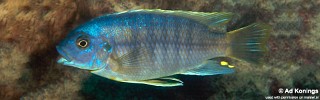
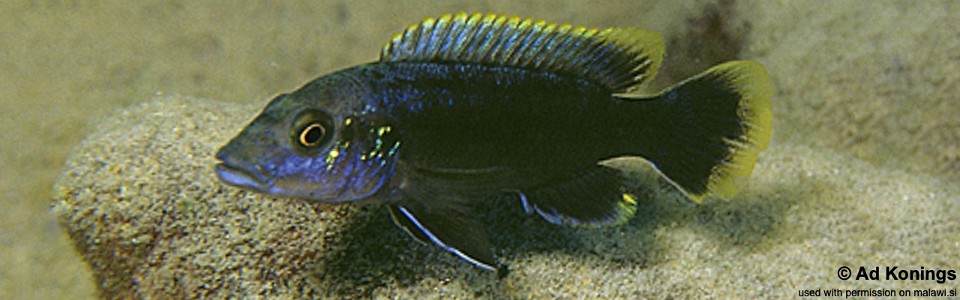




Photo gallery