Intermediate and sandy habitats, usually in water less than
15 m deep. Juveniles have been observed inhabiting empty
Lanistes nyassanus shells, whereas individuals displaying
both horizontal stripes are not associated with shells.
Geographic distribution:
Recorded around Likoma Island and its surrounding cluster
islands, including Mbuzi Island.
Typical adult size:
Largest type specimen 76.5 mm standard length,
approximately 9 cm total length.
Diet:
Feeds in groups without defending feeding territories.
Individuals pick food items from sand or rocks; open-mouth combing
of algal matrices has not been observed. When plankton is abundant,
feeding also occurs in the water column.
Special notes:
Characterized by numerous small scales on the nape and chest,
an abrupt transition from large flank scales to smaller chest scales,
and the presence of true ocelli. Adults show a basic melanin pattern
of 5–7 vertical bars (five or fewer below the dorsal fin) together
with a mid-lateral and a dorso-lateral stripe, a combination that
distinguishes mature individuals from other mbuna, including
Pseudotropheus livingstonii. Juveniles may lack distinct
horizontal elements and resemble juvenile P.livingstonii,
making reliable separation at that stage difficult.
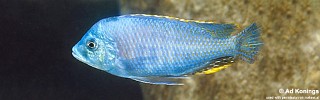
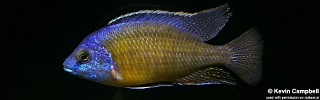
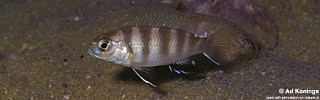
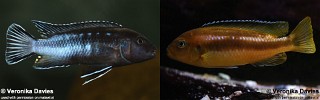
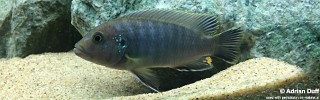
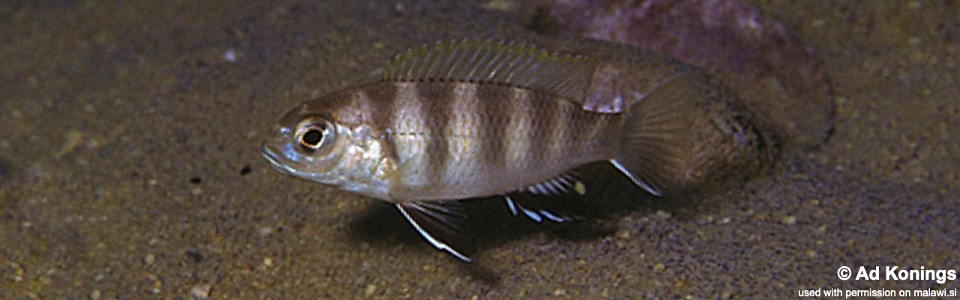




Photo gallery