Sediment-free rocky habitat. Also occurs in intermediate rocky areas and may
occasionally be found over sandy patches among rocks.
Geographic distribution:
Widely distributed in the northern half of Lake Malawi. On the west coast it occurs
from Kande Island to Mphanga Rocks; on the east coast from Cobwé to Lutara.
Also present around Likoma and Chizumulu Islands, but absent at Taiwanee Reef.
Typical adult size:
Males attain about 13 cm total length in the wild and may reach up to 15 cm in the
aquarium; females remain approximately 2–3 cm smaller (about 9–11 cm).
Sexual dimorphism:
Breeding males display a dark blue to black body with a solid light-blue midlateral
stripe and a more diffuse light-blue dorso-lateral stripe, together with a broad
black band in the spinous part of the dorsal fin. Females and juveniles have a
white to cream body with two broad black horizontal stripes and black markings
on the lower lobe of the caudal fin.
Recommended aquarium size:
An aquarium volume of 400 L is recommended.
Aquarium setup:
Provide numerous rock structures and hiding places. Keep one male with
5–6 females. Groups with multiple males are not recommended due to strong
intraspecific aggression.
Diet:
Omnivorous, feeding mainly on algae from the aufwuchs but also consuming plankton,
invertebrates, cichlid fry, and eggs of Bagrus meridionalis. It is attracted
to stirred-up sediment and may feed opportunistically. Adult females have been
observed removing fungus and anchor worms (Lernaea sp.) from larger
haplochromines, exhibiting cleaning behaviour.
Breeding:
Breeding males are present throughout the year but show territorial behaviour
mainly when other males in breeding coloration are nearby. Spawning occurs
on top of rocks, alongside rocks, and most often inside caves.
Aggression:
Aggressive within the species, particularly among males, while generally tolerant
toward other species.
Special notes:
Formerly described as Melanochromis parallelus, now regarded as a
junior synonym of M. loriae. Considered the northern sister species of
M. heterochromis but generally less common, except at Ndumbi Rocks
(Likoma Island) where large foraging groups may occur.
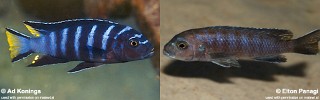
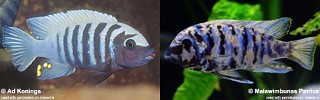
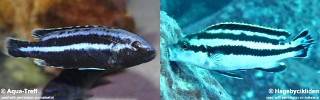
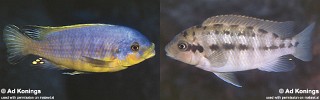
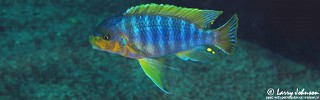
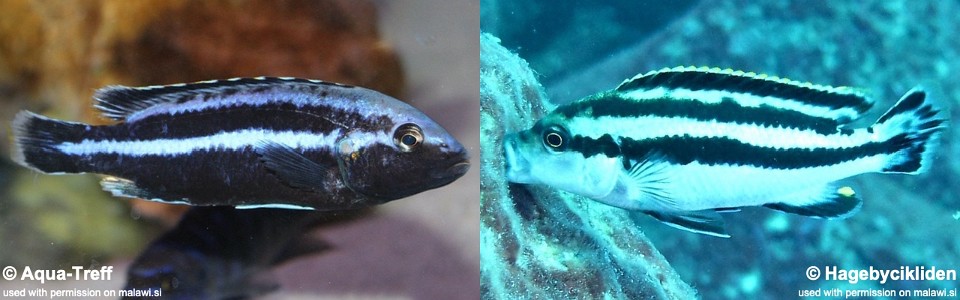




Photo gallery