Rocky habitat at depths between 7–12 m, occasionally
occurring in intermediate areas from 1–25 m.
Geographic distribution:
Known only from around Lion’s Cove on the central western
coast of Lake Malawi.
Typical adult size:
Males up to about 9 cm total length; females up to about
7 cm total length.
Sexual dimorphism:
Males are uniformly powder blue-white with a dark blue to
black face and often show a purple hue; females are light
purple-brown without vertical bars and display longitudinal
melanin patches.
Recommended aquarium size:
An aquarium volume of 250 l or a minimum tank length of
120 cm is recommended.
Aquarium setup:
Arrange a sediment-free rocky environment with numerous
shelters among rocks. Maintain 2–3 females per male or keep
groups (e.g. 3 males with 6–7 females). Avoid housing
with larger and more robust mbuna.
Diet:
Primarily herbivorous; feeds on algae and microorganisms
extracted from aufwuchs, also consuming plankton when
available.
Breeding:
Maternal mouthbrooder. Males excavate a pit beneath a stone
and defend a spawning territory; incubation lasts about
3 weeks.
Aggression:
Highly aggressive within the species; comparatively less
aggressive toward other species.
Special notes:
A small, distinctive mbuna recognizable by the male’s
uniform blue-white coloration with dark face and the short,
broad snout bearing bicuspid teeth. Males can rapidly change
coloration when disturbed. Closely associated with rocky
habitats at Lion’s Cove and considered a dwarf, strongly
territorial mbuna.
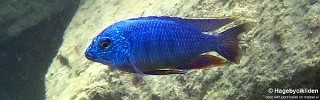
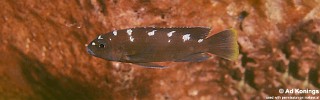
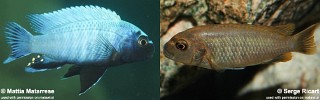
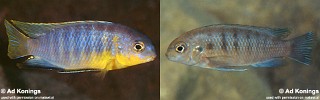
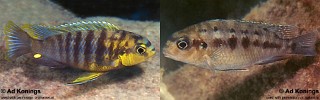
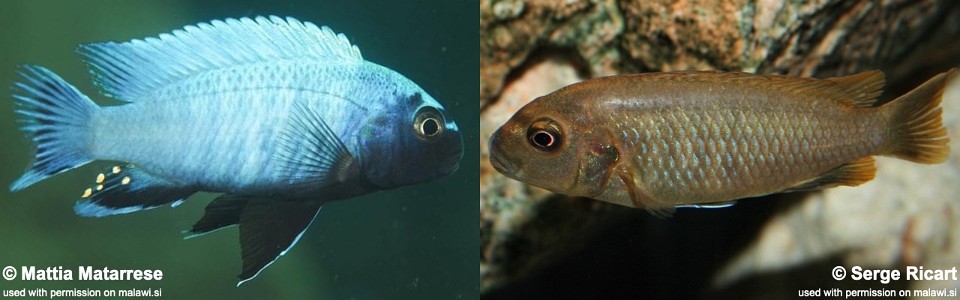




Photo gallery