Sediment-rich rocky habitat and intermediate habitats; occurs mainly over
rocky substrates.
Geographic distribution:
Lake-wide distribution in Lake Malawi.
Typical adult size:
Males up to about 14 cm total length; females about one fifth smaller.
Sexual dimorphism:
Breeding males develop a light blue nuptial coloration; outside the breeding
season males resemble females, both showing three large dark blotches on
the flanks. Females remain smaller.
Diet:
Feeds on small benthic invertebrates, mainly copepods. Uses a highly
protrusible, downward-opening mouth to vacuum-clean the algal carpet on
rocks while avoiding ingestion of coarse sediment.
Breeding:
Maternal mouthbrooder. Breeding males establish weakly defended territories
on top of rocks near sand and may carry sand up onto rocks to form a bower.
Most breeding activity occurs during or shortly after the rainy season.
Females guard their fry for three to four weeks after release.
Aggression:
Territoriality is weak and mainly directed towards conspecific males.
Special notes:
Distinguished by a high number of gill rakers (32–38) and a smaller adult
size compared to C. intermedius.


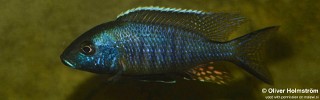
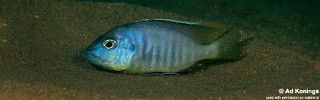
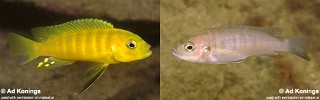
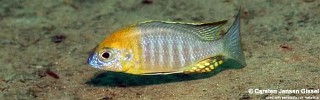
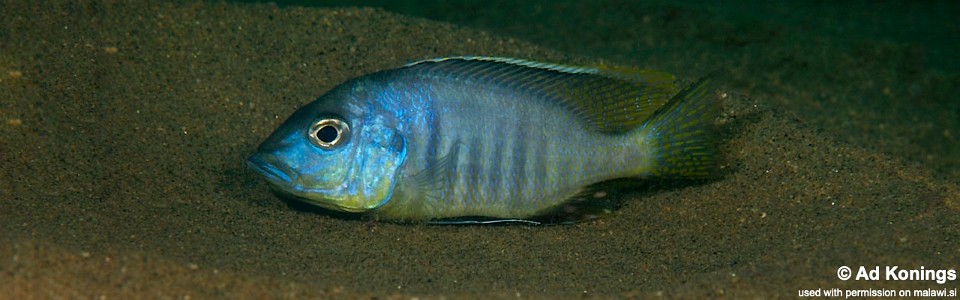



Photo gallery