Inhabits rocky habitat characterized by medium-sized to large rocks.
Usually encountered at depths of 3–15 m and is not found in high numbers.
Geographic distribution:
Occurs at Chimwalani and Luwala reefs, with additional populations reported from the area
between the Mozambique–Malawi border and the Nsinje River.
Typical adult size:
Up to 12 cm total length in wild males; females remain about 25% smaller.
Sexual dimorphism:
Males in territorial coloration show a blue ground color with 9–10 distinct black bars and a
black belly and breast; the head is black with two dark blue interorbital bars. Females are
blue-gray to green with 7–8 brown bars and a light brown belly and breast, and display a
distinct black submarginal band on the dorsal fin.
Recommended aquarium size:
A minimum tank length of 100 cm is recommended.
Aquarium setup:
Provide ample rock structures and shelters to form caves and crevices. In aquaria, more than one adult male should
only be kept together in tanks longer than 200 cm, and visually similar species should be
avoided to reduce aggression and hybridization.
Diet:
Feeds primarily on blue-green algae scraped from rocky substrate, ingesting aufwuchs and
associated algal material; plankton is also consumed when available.
Breeding:
Maternal mouthbrooder. Spawning takes place in dark recesses of the rocky habitat; males are
only weakly territorial. Females brood for about three weeks and do not feed during this
period; fry are released once free-swimming and not guarded further.
Aggression:
Generally solitary and only weakly territorial in the wild; intraspecific aggression may
occur, particularly among males.
Special notes:
Closely resembles several elongate Tropheops forms, including T. sp. ‘elongatus chizumulu’, T. sp. ‘elongatus mbako’
and T. sp. ‘elongatus reef east’. Males and females of these forms are virtually indistinguishable in coloration, and separation
based on colour alone is unreliable. These forms are currently regarded as distinct species.

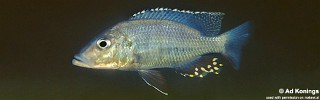
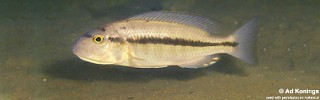
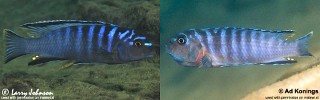
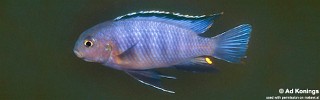
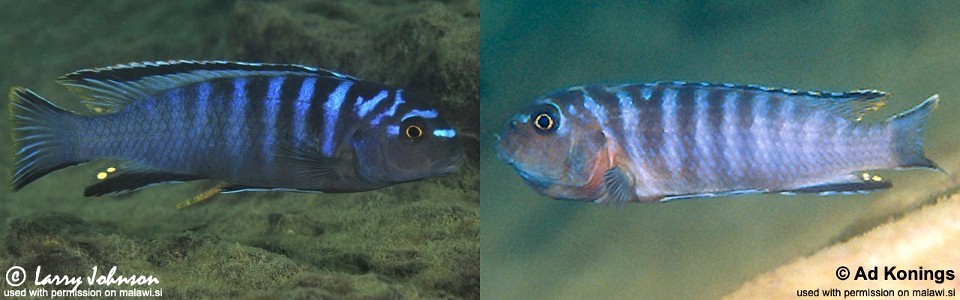



Photo gallery