Rocky habitat, primarily sediment-free areas but also transitional
zones between sediment-rich and clean rocky environments.
Occurs at depths of 3–18 m and is most numerous between
5–12 m.
Geographic distribution:
Endemic to the northeastern corner of Likoma Island, from the
eastern side of Yofu Bay to Membe Point, with the highest
population density at Maingano Island.
Typical adult size:
Up to 9 cm in males and 7 cm in females.
In aquarium conditions, both sexes may grow a few centimeters larger.
Sexual dimorphism:
Very little external difference between sexes. Both males and
females have a dark body with two horizontal pale blue stripes.
Adult males are usually slightly more intensely colored and
possess 1–5 yellow egg spots on the anal fin, while females
have one or none.
Recommended aquarium size:
An aquarium volume of 300 L with a minimum tank length of
120 cm is recommended.
Aquarium setup:
Provide abundant rockwork with numerous caves and crevices for
shelter, as well as open sandy areas. Due to intraspecific
aggression, maintain at least 3–4 females per male and keep
them in larger groups. They are best housed with robust mbuna
species of similar temperament.
Diet:
Omnivorous with a strong preference for feeding from aufwuchs.
Consumes algae, especially diatoms and cyanobacteria, along
with microorganisms, small crustaceans and plankton.
Breeding:
Weakly territorial, defending only temporary spawning sites.
Spawning likely takes place in caves between rocks. Females
brood 10–30 eggs for about 20 days and do not feed during
incubation. Fry are released and not taken back into the
mouth. Juveniles resemble adults in coloration.
Aggression:
Males are quite aggressive toward conspecifics. Aggression toward
other species is mainly observed during spawning. Group
maintenance is recommended to distribute aggression.
Special notes:
Distinguished by two horizontal pale blue stripes on a dark body
and is very similar to Pseudotropheus johannii, making males
difficult to distinguish. Historically placed in
Melanochromis due to superficial resemblance,
but later reassigned to Pseudotropheus. It is listed as Critically Endangered
(CR, 2018) due to its very restricted distribution and pressure
from the ornamental fish trade.
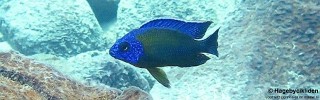
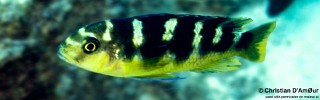
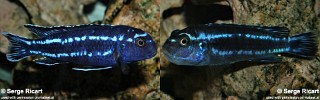
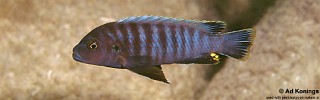
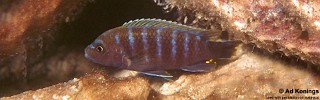
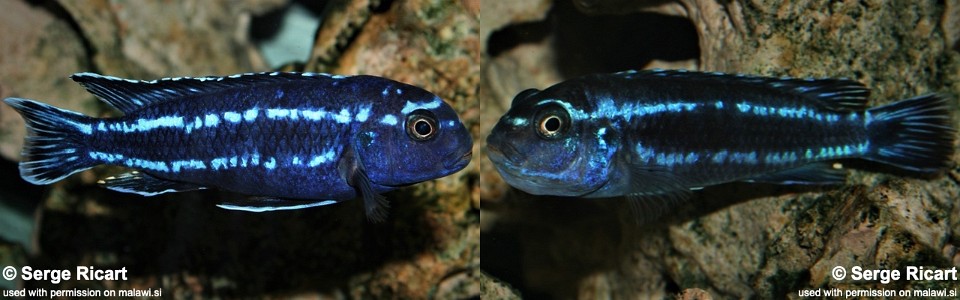




Photo gallery