Sediment-free rocky habitat. Occurs in shallow intermediate zones of rocky reefs,
most frequently at depths between 1 and 5 m, and may occasionally be seen over sand.
Geographic distribution:
Endemic to the shallow rocky reefs at Makanjila Point, Malawi.
Typical adult size:
Males attain a maximum total length of about 12–13 cm, while females remain
approximately one fifth smaller (about 10 cm).
Recommended aquarium size:
An aquarium volume of 400 L is recommended.
Diet:
Omnivorous with predatory tendencies. Feeds on eggs and larvae of the catfish
Bagrus meridionalis and has been reported to consume scales of other fishes,
particularly individuals trapped in nets. Observations in the wild do not indicate
exclusive scale-feeding behaviour. In the aquarium it attacks non-mbuna but ignores
other mbuna.
Breeding:
Usually only one male in breeding coloration is seen within a foraging group.
Territoriality has not been observed, including in the aquarium.
Aggression:
Very aggressive within the species, particularly among males, while generally
tolerant toward other species. In captivity, large groups may increase predatory
behaviour toward non-mbuna.
Special notes:
Males lose the female and juvenile pattern of dark transverse body bars and
become silvery to light blue, often with a golden sheen behind the head and a
prominent black caudal spot. Females resemble those of related species but can
be distinguished by the black trailing edge of the tail. The species name
refers to scales found in stomach contents of examined specimens.
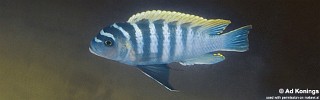

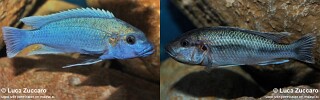
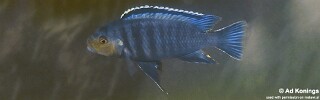
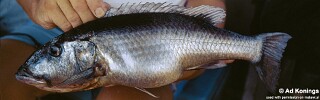
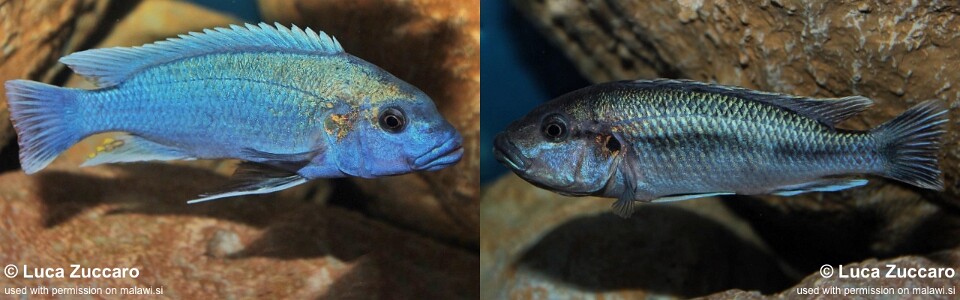




Photo gallery