Sediment-free rocky habitats among medium to large rocks,
from the extreme shallows to at least 33 m depth.
Geographic distribution:
Occurs in the sediment-free rocky habitats around the
Nankumba Peninsula, on all islands surrounding that peninsula,
and at the Maleri Islands.
Typical adult size:
Males reach around 12 cm total length in imports
and may grow larger in captivity; females remain
approximately 25% smaller.
Sexual dimorphism:
Males are steel blue with orange-yellow head and chest,
longer fins and larger anal ocelli; females are beige-yellow.
OB morphs occur in both sexes, with males showing blue
hues within the blotched pattern.
Recommended aquarium size:
An aquarium volume of at least 400 L is recommended,
with a minimum tank length of 140 cm; to maintain more
than one active male, a length of around 200 cm is required.
Aquarium setup:
Provide abundant rock structures forming caves and crevices,
interspersed with open sandy areas. A ratio of one male to
5–6 females is advised to disperse intraspecific aggression.
Best combined with other robust mbuna genera.
Diet:
Primarily feeds on the algal layer of rocks and associated
invertebrates; plankton may be consumed when abundant.
In aquarium, a vegetable-rich diet is required.
Breeding:
Maternal mouthbrooder. Males excavate shallow pits beneath
stones and defend territories aggressively. Females incubate
eggs for about three weeks.
Aggression:
Highly aggressive and strongly territorial toward
conspecifics and other species; adults defend rock-top
territories intensely.
Special notes:
Characterized by steel-blue males with orange chest
coloration and the occurrence of OB morphs in both sexes,
a rare feature within the genus. According
to Ad Konings (2022), true Tropheops tropheops
corresponds to the form formerly known as
Tropheops sp. ‘broadmouth’, while the species he
earlier regarded as T. tropheops is now referred
to as Tropheops sp. ‘orange chest’.
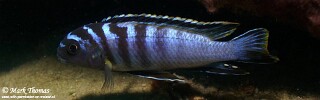
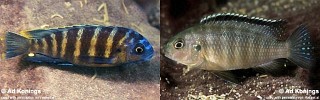
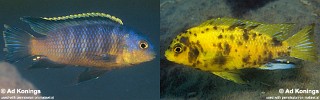
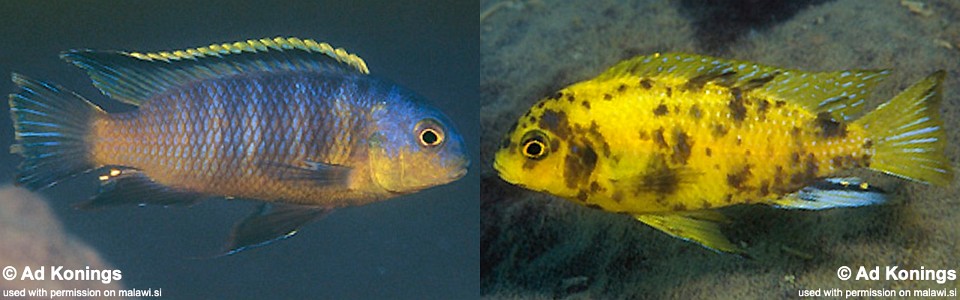




Photo gallery